


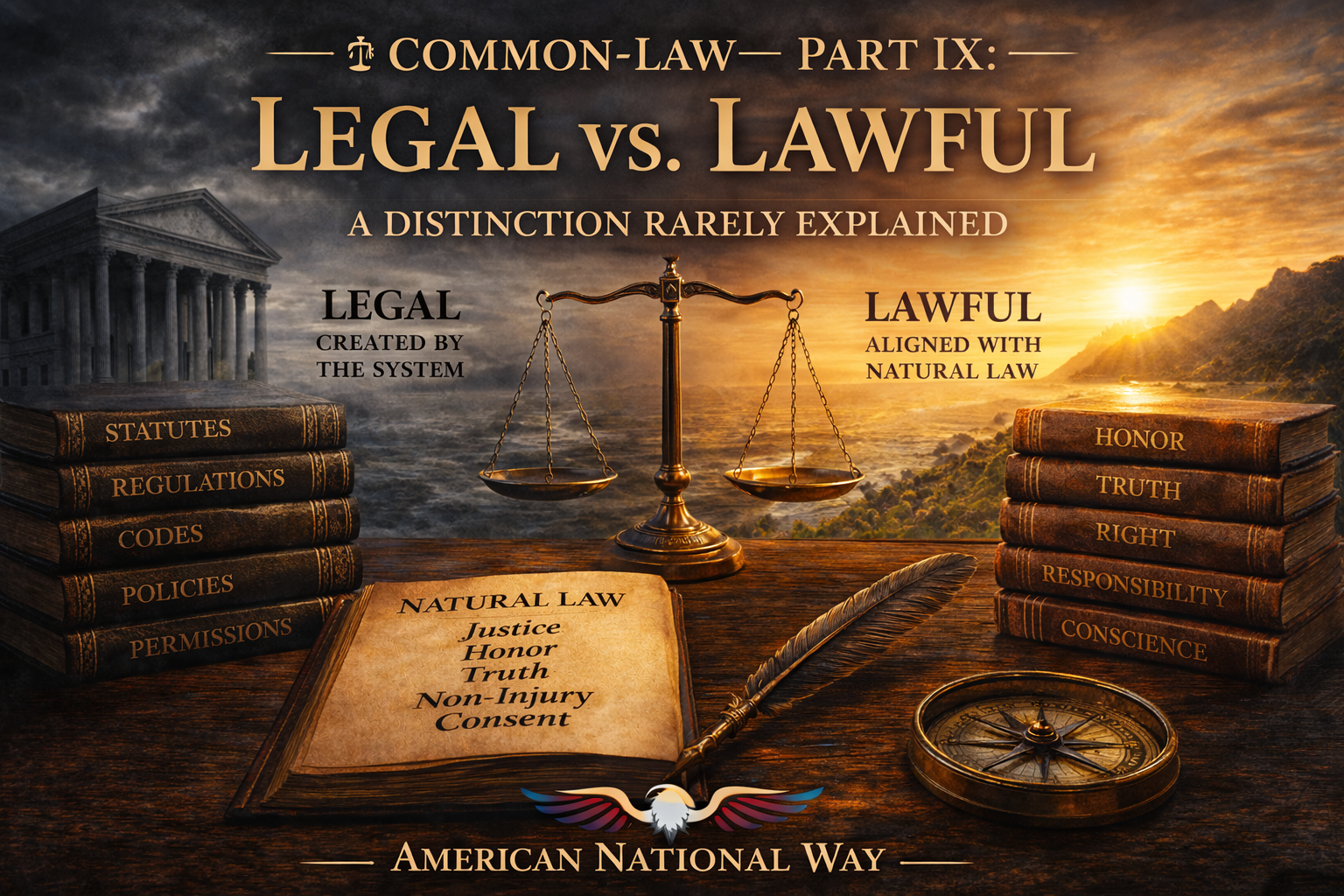
Howard Freeman often noted that one of the most damaging confusions in modern society is the belief that legal and lawful mean the same thing.
They do not.
Wolf country thrives on this confusion. Sheep suffer because of it.
📜 What “Legal” Actually Means
Something is legal when it conforms to:
- Rules
- Statutes
- Regulations
- Procedures
Legality depends on enactment and enforcement, not on right or wrong.
A rule may be legal even if it is unjust, excessive, or improperly applied.
⚖️ What “Lawful” Actually Means
Something is lawful when it aligns with:
- Proper authority
- Jurisdiction
- Right
- Duty
- Harm or injury
Lawfulness asks a deeper question:
By what right does this apply?
Freeman emphasized that lawfulness precedes legality — not the other way around.
🧠 How the Two Became Entangled
Freeman explained that as systems expanded, legality slowly replaced lawfulness.
Efficiency, volume, and control favored rules that could be uniformly enforced, regardless of context.
Over time:
- Procedures replaced principles
- Compliance replaced conscience
- Enforcement replaced authority
Sheep were trained to obey what is legal without asking whether it is lawful.
🧾 Enforcement Does Not Equal Authority
One of Freeman’s repeated cautions was this:
Enforcement proves power — not right.
Many actions appear legitimate because they are enforced, not because they are lawful.
Sheep often mistake consequence for correctness.
🕊️ Calm Discernment Prevents Conflict
Freeman did not teach people to reject everything legal.
He taught discernment.
A disciplined man or woman:
- Observes whether a demand is legal or lawful
- Notes the jurisdiction involved
- Avoids emotional reaction
- Preserves record
Understanding the difference prevents unnecessary confrontation.
🔍 When Legal Overrides Lawful
Freeman warned that when legality overrides lawfulness:
- Rights erode quietly
- Duties expand endlessly
- Authority becomes procedural
Systems no longer need to justify themselves — only to enforce.
🧱 Lawful Standing Requires Clarity
A sheep who confuses legal with lawful will:
- Argue fairness where procedure rules
- Assert rights where jurisdiction is absent
- Expect justice where only compliance is offered
Clarity restores footing.
🕯️ What This Understanding Reveals
When the difference between what is legal and what is lawful becomes clear, attention naturally turns to the foundation beneath both. If procedures and permissions can operate within a system, what ensures that law itself remains grounded in truth? It cannot rest on form alone, nor on assumption carried forward without question.
Part X — Corpus Delicti returns to that foundation, showing that for law to exist in substance, there must be an actual injury — something real, measurable, and present — rather than a presumption built on appearance or claim.