


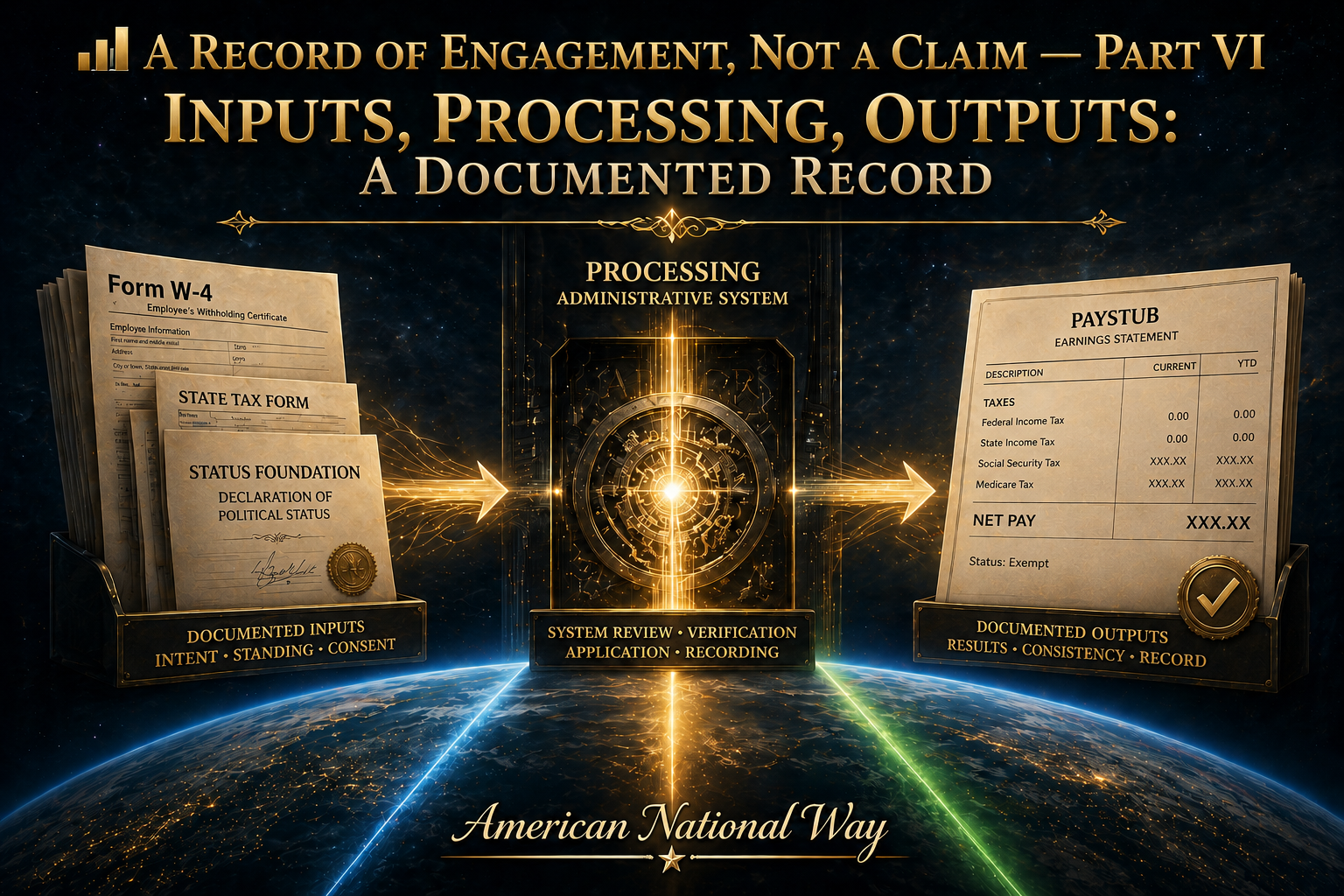
This series has, until now, dealt in frameworks, history, distinctions, and foundational processes.
This part is different.
This part presents evidence. Not theory. Not philosophy. Not interpretation. Simply a documented record of what changed when one individual changed how they engaged with administrative systems — and what the systems produced in response.
The record spans from 2021 to 2026. It covers three separate employers. It includes forms submitted, confirmations received, and payroll outputs generated across multiple years and pay periods. Every element described here is drawn from actual documents — emails, paystubs, tax forms, and institutional correspondence.
It is presented in the same spirit as everything else in this series: as observation, not argument. The reader is invited to examine what occurred and to draw their own conclusions.
Lawful Lane Scope Note: This article documents one living man’s records and observed outcomes after establishing a public-record foundation and engaging administrative systems from a Lawful Lane posture. It is not instruction for the general public, Legal Lane participants, or anyone seeking payroll, tax, banking, or form-completion guidance. It does not advise any reader how to complete an I-9, W-4, G-4, payroll form, tax form, check endorsement, or banking instrument. Each man or woman studying the Lawful Lane remains responsible for their own research, competent counsel where needed, decisions, and conduct.
🧭 The Sequence: Foundation → Inputs → Processing → Outputs
Before examining the evidence, it is worth restating the sequence described in Part V.
Foundation was established first. The 928 paperwork — served in May 2021 through The Georgia Assembly — created a documented public record of identity, standing, and intent. This was the compass.
Only after that foundation was in place did administrative inputs change. Forms were completed differently. Identity was presented differently. Engagement with institutional systems shifted from default participation to intentional, documented interaction.
The systems then processed those inputs. They did not evaluate philosophy. They did not assess political standing. They did what systems do — they received inputs, applied their internal logic, and produced outputs.
The outputs are what this part documents.
📜 The Forms: What Changed in the Inputs
When one enters employment within the Legal Lane, several administrative forms establish how the system classifies and processes the individual. The most significant of these, for purposes of this record, are the federal I-9 form, the federal W-4 form, and the state withholding form (for Georgia, the G-4).
The I-9 — Employment Eligibility
The I-9 is the federal form used to verify employment eligibility. It includes a section where the individual attests to their citizenship or immigration status.
The I-9 provides four options. Option 1 is “A citizen of the United States.” Option 2 is “A noncitizen national of the United States.” Option 3 is “A lawful permanent resident.” Option 4 is “An alien authorized to work.”
In this study, the I-9 submitted after status correction selected Option 2 — a noncitizen national of the United States. This option exists on the form as printed by the Department of Homeland Security. It is not a modification, not an addition, and not an unauthorized entry. It is one of the four standard selections provided by the form itself.
Within the framework of this series, this selection aligns with the standing established in the 928 paperwork — specifically, the Declaration of Political Status, which references the definition of “national” under federal code.
The W-4 — Federal Withholding
The W-4 is the form through which an employee communicates withholding preferences to their employer. It determines how much federal income tax is deducted from each paycheck.
In the standard configuration — the default that most employees accept without modification — the W-4 results in federal income tax being withheld from every pay period based on serving status, dependents, and other standard inputs.
In this study, the W-4 submitted after status correction was completed differently. The withholding designation was marked as EXEMPT. The form was autographed — not signed — with a reservation of rights notation: “All Rights Reserved, Without Prejudice.” The Social Security number field included a notation indicating that it was provided for identification purposes, not as a tax identification number.
This is described only as the input used in this documented record, not as instruction or eligibility guidance for any other reader.
These are input changes. They communicate specific information to the payroll system about how to process the individual’s compensation.
The G-4 — State Withholding
The G-4 is the State of Georgia’s withholding form — the state-level equivalent of the federal W-4.
In the standard configuration, this form results in Georgia state income tax being deducted from each pay period.
In this study, the G-4 submitted after status correction utilized Section 8 of the form — the exemption section. This section, printed on the form itself by the Georgia Department of Revenue, provides a checkbox for claiming exemption from withholding. The form was completed accordingly, with the exemption claimed and the autograph accompanied by the same reservation of rights notation.
I-9, W-4, and G-4 Tax Forms — Example Images


⚡ The Processing: Institutional Response
What happened after these forms were submitted is documented through direct correspondence from the employers’ human resources / payroll departments.
Employer One — Corporation A, Inc. (2022)
On May 31, 2022, correspondence was sent to the employer’s human resources department inquiring about the processing of the W-4 and G-4 forms that had been submitted.
On June 15, 2022, the human resources representative responded directly. The communication stated that the individual’s profile had been marked to be exempt from Federal Withholding and State Withholding. It confirmed that the change would reflect on the next week’s payroll. It further stated that the only taxes that would continue to apply were Social Security and Medicare taxes.
This was not a negotiation. It was not an argument. It was an administrative process: forms were submitted, the system processed them, and the human resources department confirmed the resulting configuration.


Employer Two — Corporation B, LLC (2025)
Upon beginning employment with a second employer in 2025, the same process was followed. Updated W-4 and state withholding forms were submitted, completed in the same manner as described above.
On September 25, 2025, the human resources department responded. The communication stated that based on the W-4 and state tax forms submitted, tax elections had been updated in their system. It confirmed that both federal and state withholding were now set to reflect exempt status.
A different employer. A different human resources department. A different payroll system. The same inputs produced the same processing outcome.


Employer Three — Corporation C, Inc. 501(c)(3) (2026)
With a third employer — a 501(c)(3) tax-exempt organization — the same process was followed once more. The same forms were submitted with the same configurations.
The payroll record for January 2026 reflects the result. Federal withholding status is listed as Exempt. State withholding status is listed as Exempt. Federal income tax withheld: zero. Georgia state income tax withheld: zero. Social Security and Medicare contributions continue to be deducted as expected.
Three employers. Three separate human resources departments. Three separate payroll systems. Spanning four years. The same foundation, the same inputs, and the same outputs — consistently. It’s mechanical and systematic.


📊 The Outputs: Before and After
The most direct evidence of this process is found in the payroll records themselves.
Corporation A, Inc.
Before Status Correction — Aug 2020 to June 2022
Employer: Corporation A, Inc.
Payroll processor: ADP
Weekly Gross pay: $1,881.74
Deductions:
- Social Security Tax: −$116.67
- Medicare Tax: −$27.28
- Federal Income Tax: −$274.90
- Georgia State Income Tax: −$98.91
Net pay: $1,363.98
This was the standard configuration — the default output of a system processing a standard set of inputs.


After Status Correction — June 2022 to August 2024
Employer: Corporation A, Inc.
Payroll processor: ADP
Weekly Gross pay: $1,957.01
Deductions:
- Social Security Tax: −$121.34
- Medicare Tax: −$28.37
- Federal Income Tax: −$0.00
- State Income Tax: −$0.00
Net pay: $1,807.30
Last Paycheck from Corporation A
Weekly Gross pay: $2,178.16
Deductions:
- Social Security Tax: −$135.05
- Medicare Tax: −$31.58
- Federal Income Tax: −$0.00
- State Income Tax: −$0.00
Net pay: $2,011.53
The only deductions remaining are Social Security and Medicare — contributions that continued in the records presented here.. Federal and state income tax withholding: zero.


Corporation B, LLC. — September 2025
Gross pay: $1,634.80
Payroll processor: Internal
Deductions:
- FICA Tax (Social Security): −$101.36
- FICA Med (Medicare): −$23.71
- Federal Tax: −$0.00
- Georgia State Tax: −$0.00
Net pay: $1,509.73
Corporation B refused to send paychecks by mail and instead required direct deposit. As an alternative, a monthly bank statement with Redemption using “12 U.S.C. §411 – in Lawful Money” can be sent to the Union Credit Union CEO. Note: the first weekly paycheck was not yet processed with Federal and State exemption.


Corporation C, Inc. 501(c)(3) — May 2026
Gross pay: $5,583.33
Payroll processor: Internal
Deductions:
- Federal OASDI (Social Security): −$342.14
- Federal Medicare: −$80.02
- Federal Withholding: −$0.00
- Georgia Withholding: −$0.00
Net pay: $4,537.84


🧠 What the Record Demonstrates
This record does not prove a legal theory. It does not validate a political philosophy. It does not establish that any particular status carries any particular legal consequence.
What it demonstrates is something simpler and more fundamental:
Systems respond to inputs.
When the inputs changed — when forms were completed differently, when identity was presented through a different selection on a standard government form, when withholding was designated as exempt using the exemption provisions printed on the forms themselves — the system processed those inputs accordingly.
The outputs changed not because the system was convinced of anything. Not because it recognized a different jurisdiction. Not because it acknowledged a philosophical framework. The outputs changed because the inputs changed.
This is how administrative systems work. They receive. They classify. They process. They output.
This case study shows: the individual did not fight the system. Did not argue with the system. Did not demand that the system change. The individual simply changed the inputs — consistently, with documented foundation, across multiple employers and multiple years — and observed the results.
📋 The Banking Dimension
One additional dimension of this record deserves mention.
After status correction, the way compensation was received also changed. Rather than direct deposit into a commercial bank account, compensation was received by physical check. The check was then endorsed with specific language: “All rights reserved and Redeemed — 12 U.S.C. §411 — in Lawful Money.”
This endorsement references the statutory provision regarding the redemption of Federal Reserve Notes in lawful money. Within the framework of this series, it represents one more point of intentional, documented interaction — a conscious choice about how to receive and process the value of one’s labor.
In the author’s observed lawful experience, a credit union must be used rather than a commercial bank, and the author found that member-based credit union institution allows account establishment using alternative identification credentials, including the American State Citizen Credentials issued by The American States Assemblies.
These are operational details. They reflect the practical reality of conducting oneself intentionally across different systems of engagement. They are not presented as universally applicable steps, but as documentation of what occurred in this particular experience.
🛡️ What This Record Is — And What It Is Not
This record documents one individual’s experience over a defined period of time, supported by verifiable documents.
It is not a guarantee that others will experience identical outcomes. It is not a prescription for action. It is not legal advice. And it is not a claim that the legal subsystem has recognized, validated, or endorsed any particular status or philosophy.
What it is, simply, is a pattern:
Foundation was established. Inputs were changed. Processing occurred. Outputs were observed. Consistency was maintained. And the pattern held — across employers, across years, and across payroll systems.
Whether this pattern reflects a deeper truth about the nature of administrative systems, or whether it reflects something else entirely, is left to the reader’s own discernment.
The record simply shows what happened.
🧩 Closing Reflection
There is a moment in every system administrator’s experience when a seemingly complex problem is resolved not through force, not through argument, and not through extraordinary measures — but through the simple, precise correction of an input.
The system was never broken. The output was never random. The configuration was simply set to a default that nobody had questioned.
When the input changed, the output changed.
That observation — quiet, repeatable, and entirely impersonal — may be the most important thing this series has to offer.
Not a battle. Not a victory. Not a revolution.
Just a configuration change. And the patience to observe what follows.
This article is not legal advice. It is a documented record of one individual’s experience with administrative systems over a defined period. No claim of universal applicability, legal exemption, or institutional recognition is being made. Outcomes described here are specific to the circumstances documented and should not be interpreted as guaranteed or replicable without independent research and personal responsibility.