📋 A Record of Engagement, Not a Claim — Case Study — Closed Payroll Tax Ticket

📜 Summary
This note is being written for educational purposes only regarding a payroll tax ticket opened on April 2, 2026, and closed lawfully.
When employment began with Corporation C, the I-9 form was completed selecting “A noncitizen national of the United States” — one of the four standard options printed on the form by the Department of Homeland Security. The W-4 and G-4 state withholding forms were completed accordingly, autographed with seal and the notation “All Rights Reserved — Without Prejudice,” and submitted as physical paper documents.
For approximately four months, paychecks reflected both Federal and State tax exemption — consistent with the forms submitted and the status established.
The issue appeared after a payroll/tax record change occurred on February 17, 2026. No notification was provided before or after this change was made.
After that February 17, 2026, change, the February 2026 paycheck began reflecting Federal tax being applied, while State tax was still not applied.
The February 17, 2026, alteration was discovered only after speaking with the main/head office IT Support team. They confirmed that the record had been altered on that date but did not provide the name of the individual who made the change.
Based on the information available, the email communications and ticket activity that followed were caused by the February 17, 2026, payroll/tax record alteration, which was made without notice. It appears to have been based on an assumption rather than a confirmed update submitted by the employee.
The ticket is now closed. No further follow-up is being requested at this time. This note is for educational documentation only.
Lawful Lane Scope Note: This case study documents one living man’s records and observed outcome after establishing a public-record foundation and engaging administrative systems from a Lawful Lane posture. It is shared for Assembly members and readers studying Lawful Lane conduct after foundation has been established. It is not instruction for the general public, Legal Lane participants, or anyone seeking payroll, tax, banking, or form-completion guidance. Each man or woman remains responsible for their own research, competent counsel where needed, decisions, and conduct.
🔍 Annotated Email Correspondence
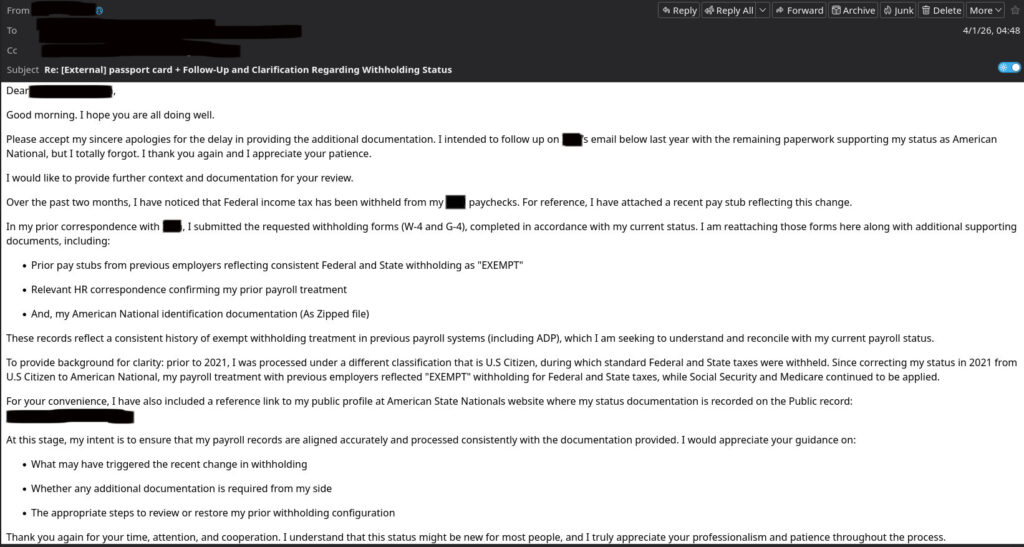
The emails below are read from bottom to top — as they appear when scrolling up in an email client. The first image shows the follow-up email regarding a ticket that had been open for almost a month.
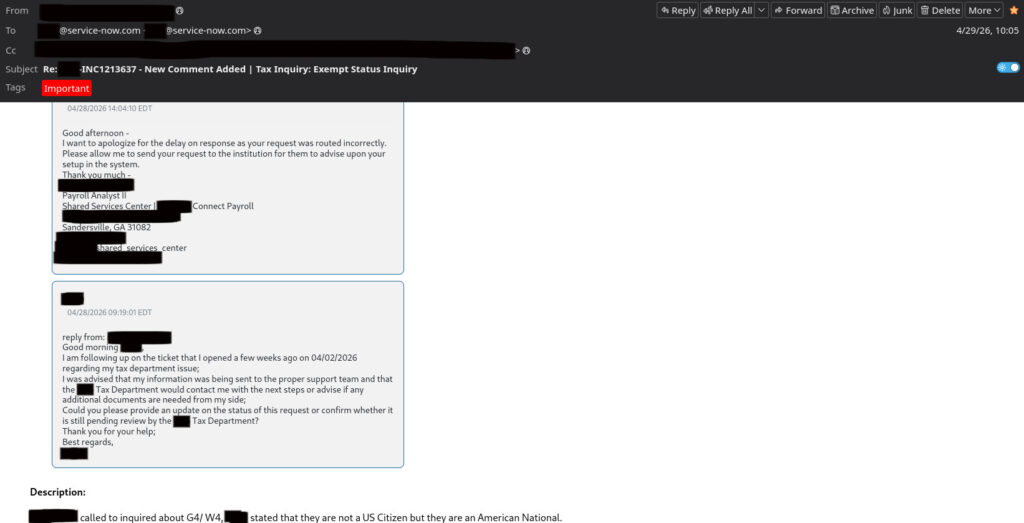
During all the email communication in this thread, none of the Payroll Team addressed me using my Christian lawful name. They used “As this Employee” instead.
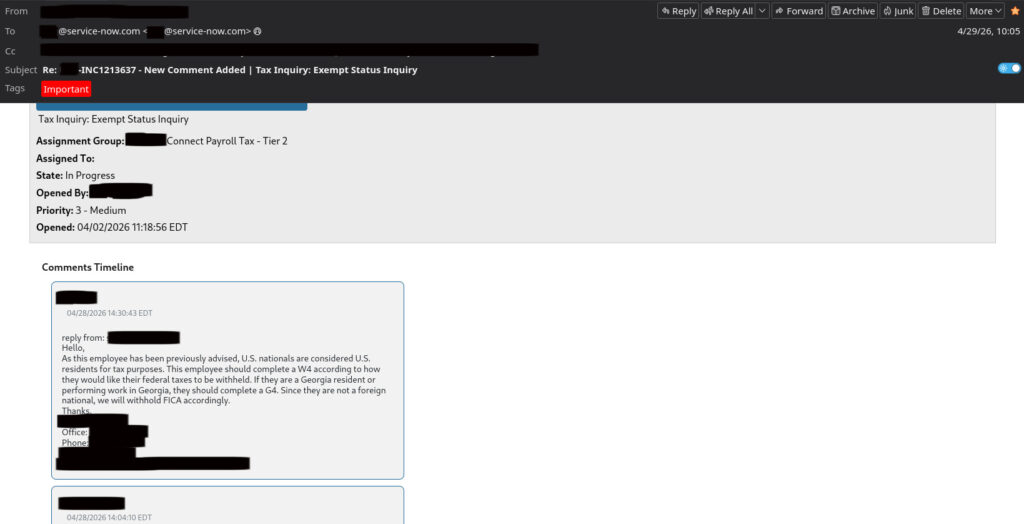
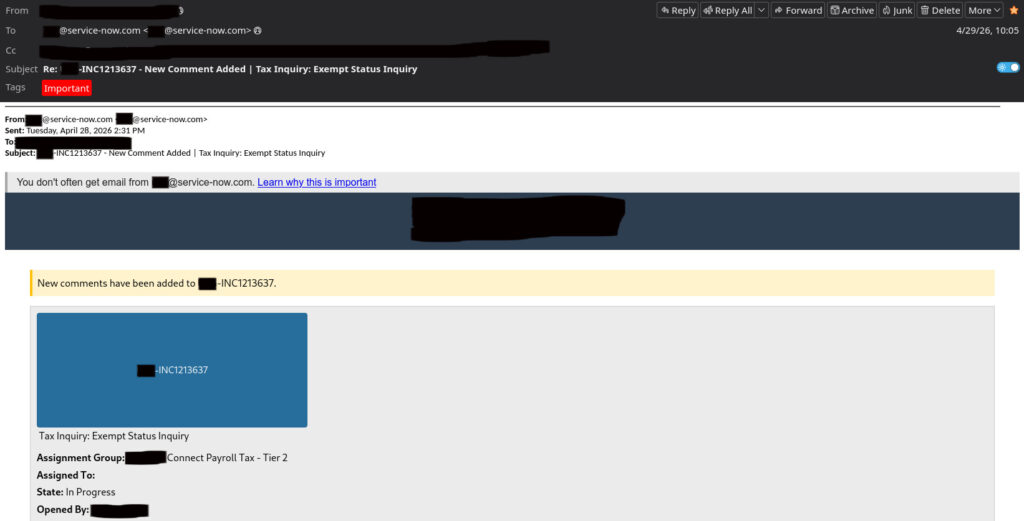
The moment I knew the person who was supposed to handle my ticket, I initiated the communication immediately, directly to them using my work email client instead of using the ticket web interface, and CC’ing to my personal email. So what you see below are the CC’d emails which were copied into my personal email inbox while communicating with the Payroll and Accounting Team.
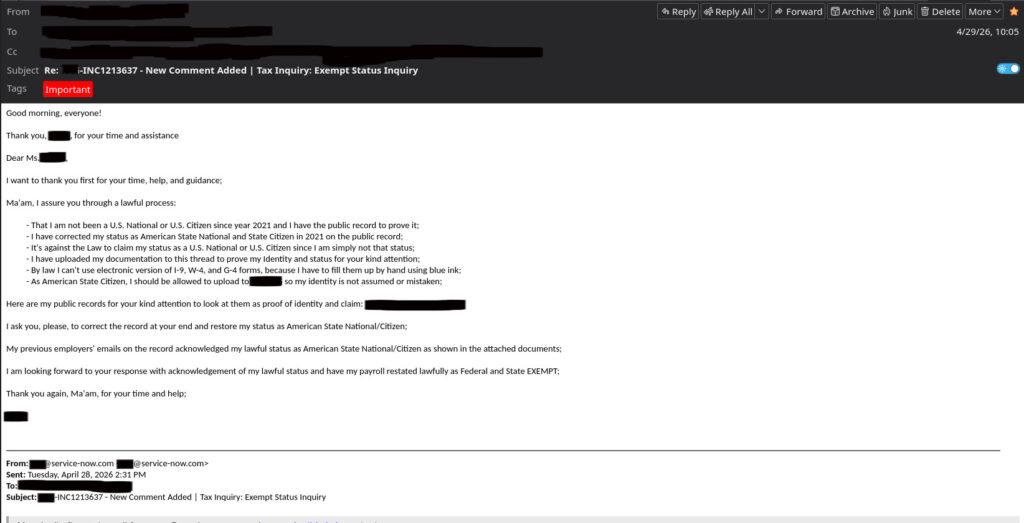
Important: As a living man or woman, I avoid submitting paperwork as electronic forms signed electronically, especially, when dealing with De Facto forms such as the I-9, W-4, and G-4.
Therefore my request below was: How should I upload my paperwork, which is autographed using my seal with “All Rights Reserved — Without Prejudice” for the W-4?

The constant response from the Payroll and Accounting team was to fill the forms electronically; and that is not lawful for my status.
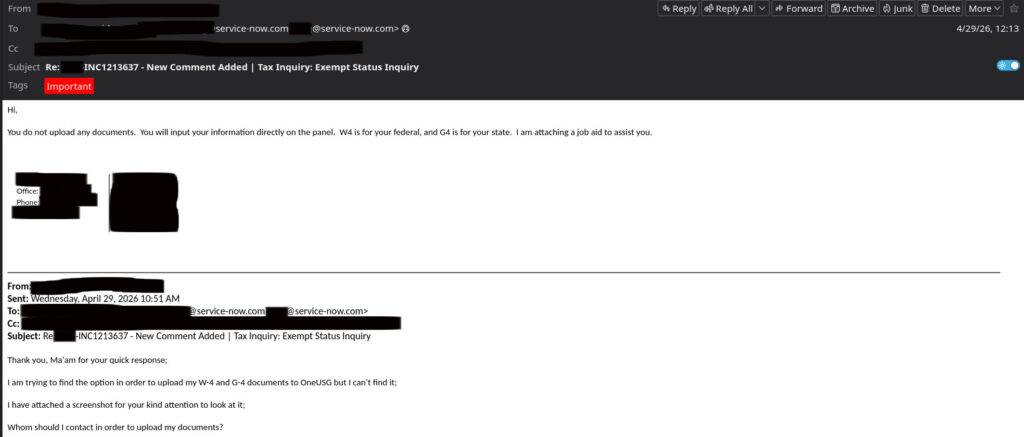
Below is my lawful response, which sealed the deal. Please note each word being used; one’s response should always be written with respect and honor.
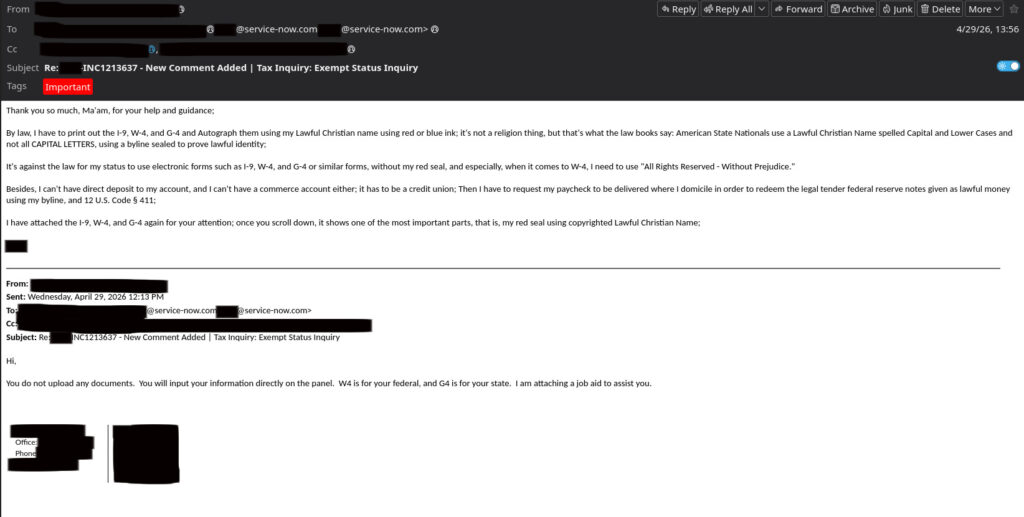
The Payroll/Accounting agent’s response below was finally an acceptance of the lawful process, which clearly shows an acknowledgment of the fact. I, as a lawful person, will be provided a way to upload my lawful process as requested. However, always respond with an attachment and CC your personal email. Feel free to use their secure method as well as an extra step, but a direct response with CC’ing your personal email is a must for your records.
As you will notice below, it turns out that the IRS has changed the process and is requesting a new W-4 form to be used every year. The Payroll and Accounting Department never notified me of this new requirement by the IRS the way they notified me below. When I submitted my paperwork last year, it was accepted; but it was not valid for 2026. Instead of letting me know that I needed to use a 2026 W-4 form, they assumed and altered the record without notice, which caused the system to apply Federal tax in February, March, and April — until this email thread communication took place.
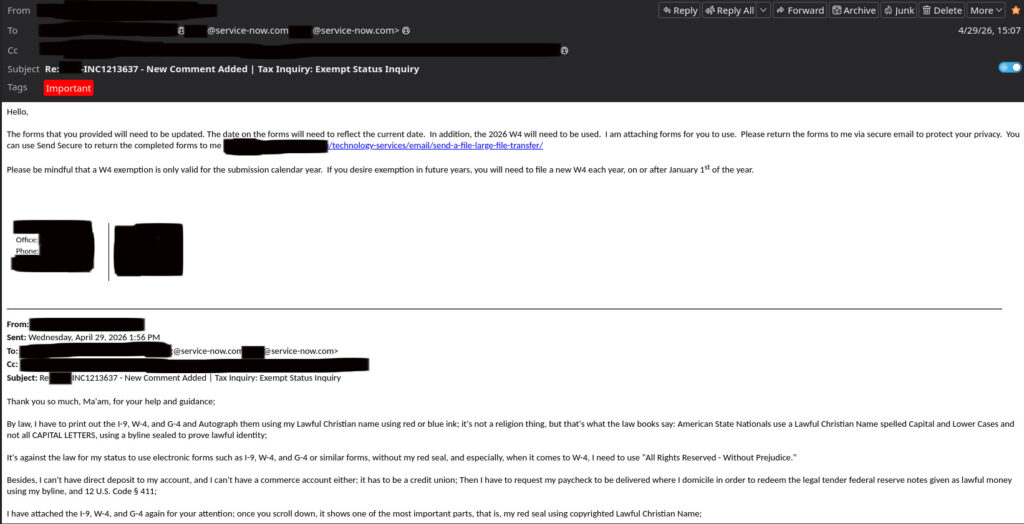
As seen below, my response included an attachment and was CC’d to my personal email for my records.
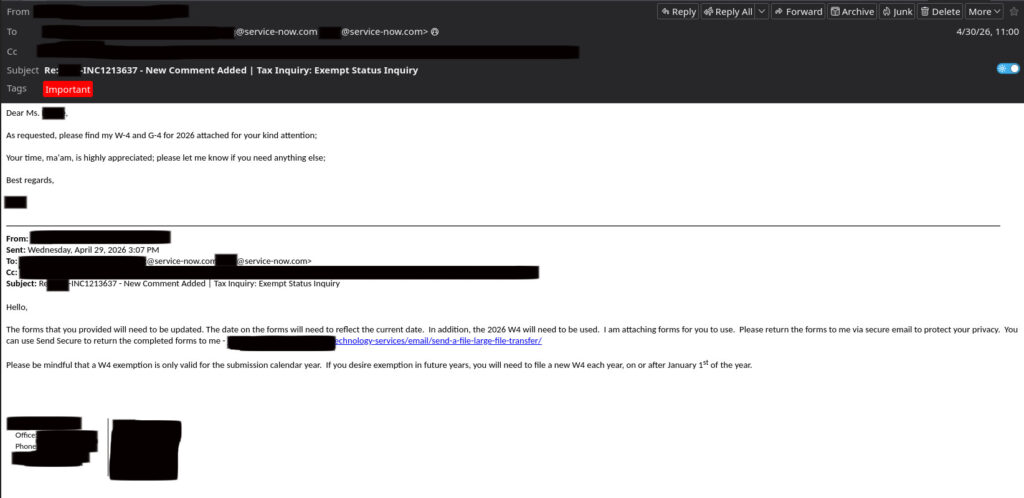
Next, another agent was added to the thread. It seems this agent is letting me know that they will refund the Federal tax they withheld for February, March, and April. Frankly, I am not certain whether they will or will not refund the money. This situation would not have occurred in the first place if there had been proper correspondence on record to let me know that I needed to use the new W-4 form. Instead, my record was altered without any type of communication or verification — the agent who altered my records assumed, without any obligation to verify.
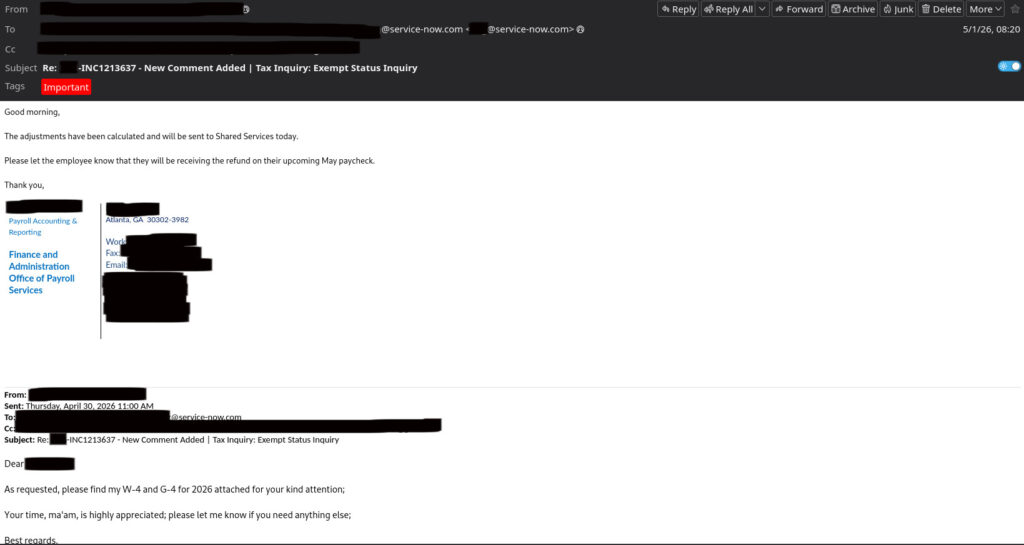
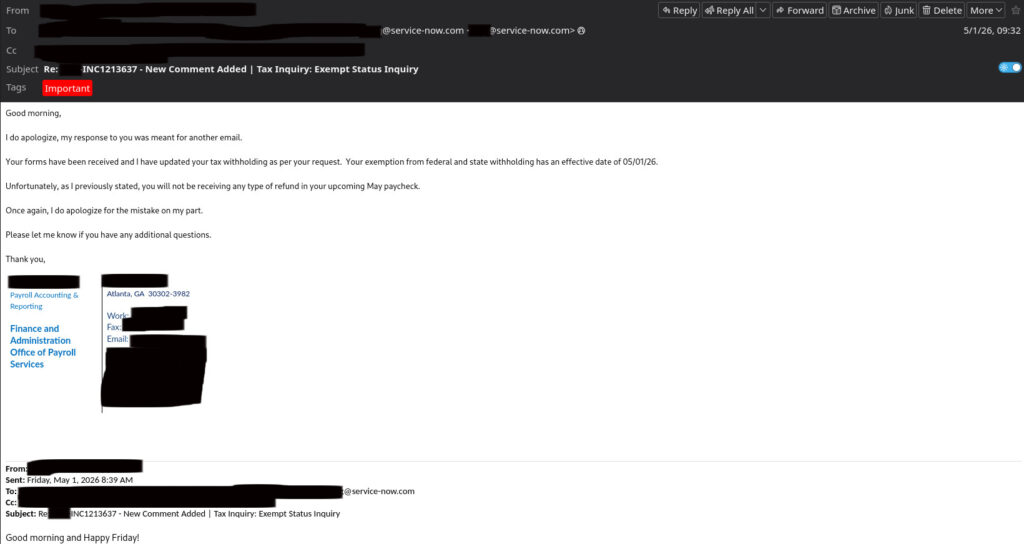
The next email continued the record. I am still not sure if they will refund the money; time will tell. The important part is that I received an acknowledgment that the forms have been received and I will be EXEMPT as requested.
It is important to note that I had shared all my paperwork with the Payroll and HR departments prior to this exchange. The communication above took place while I was establishing contact to figure out what had happened and why Federal tax was being applied. They already had all my paperwork before the correspondence documented above took place.
📌 Observation One — Naming Convention
During all email communication in this thread, none of the Payroll Team addressed the employee using their Christian lawful name. They used “As this Employee” instead. Within the framework documented across this series, this is consistent with the observation that the Legal Lane subsystem does not address the living man — it addresses the record, the classification, the employee file.
📌 Observation Two — Direct Communication
The moment the identity of the person assigned to handle the ticket was known, communication was initiated directly using the work email client rather than the ticket web interface. All correspondence was CC’d to a personal email address — ensuring that a complete record existed outside the corporation’s systems.
📌 Observation Three — The Electronic Form Request
The Payroll and Accounting team’s consistent response was to request that the forms be filled out electronically.
For a living man or woman operating under the Lawful Lane, electronic submission of de facto forms — particularly the I-9, W-4, and G-4 — is not lawful for that status. In this documented process, the forms were preserved as autographed by living hand, with seal, and with reservation-of-rights notation. Electronic signatures do not carry the same jurisdictional standing as a wet-ink autograph.
Within the author’s Lawful Lane practice, de facto paperwork such as the I-9, W-4, and G-4 was not submitted as electronically signed forms. The author preserved wet-ink autograph, the seal, and the reservation of rights are jurisdictional markers — they communicate which lane subsystem the individual operates under.
📌 Observation Four — The Lawful Response That Resolved the Matter
The response that resolved the impasse was composed with precision — every word chosen carefully, delivered with respect and honor. No hostility. No accusation. No demands framed in Legal Lane syntax. Simply a clear, calm statement of how the paperwork would be submitted and under what terms.
The Payroll and Accounting agent’s response was an acceptance of the lawful process — providing a way to upload the autographed documents as requested.
This confirms the pattern documented across the entire body of work: systems respond to inputs. When the input is clear, consistent, and grounded in proper foundation, the system processes it accordingly. The resolution came not through argument but through conduct.
📌 Observation Five — The Root Cause
The investigation revealed that the IRS had changed its requirements, mandating a new W-4 form to be submitted each year. The Payroll and Accounting Department did not notify the employee of this new requirement.
When the previous year’s W-4 form expired, rather than contacting the employee to request an updated form, an agent altered the payroll record without notice — causing the system to apply Federal tax to the February, March, and April paychecks.
This is the Legal Lane subsystem’s law of assumption in action. The agent assumed — without verification, without communication, without any obligation to confirm — and altered the record based on that assumption. The system then processed the altered input and produced a different output.
The assumption was not malicious. It was procedural — an agent following the path of least resistance within a system that treats assumption as standard operating protocol. But the consequence was real: three months of Federal tax applied to paychecks that should have reflected exempt status.
📌 Observation Six — Acknowledgment and Resolution
The final communications confirmed that the autographed forms had been received and that the exempt status would be restored as requested. A separate agent indicated that a review of the Federal tax applied during February, March, and April would be conducted.
The ticket was closed. The exempt status was restored. The record was corrected.
🧩 Closing Note
Nothing personal occurred in this exchange. Most de facto government agents and corporate payroll administrators do not know about the de jure government process. They operate within the Legal Lane subsystem’s protocols — following procedures, processing inputs, applying assumptions — because that is what they were trained to do.
This correspondence may have provided an opportunity for the agents involved to learn something about the distinction between lawful standing and de facto corporate government process. That learning, if it occurred, is a contribution — not a confrontation.
The complete paperwork — including the 928 foundation documents, the W-4, the G-4, and the I-9 — was shared with the Payroll and HR departments months before this email exchange took place. The foundation was already established. The inputs had already been submitted. The system had already processed them correctly for four months.
The disruption was caused not by the employee’s status — but by an unauthorized alteration of the record, made without notice, based on assumption rather than verification.
When the input was corrected, the output was corrected. That is how systems work.
📌 Editorial Note — On Assumption, Alteration, and the Discipline of Documentation
This case study illustrates a principle documented throughout the body of work published by American National Way: the Legal Lane subsystem operates through assumption. When no objection is raised, assumption governs. When an input expires without renewal, assumption fills the gap. When an agent does not know the nature of the individual’s standing, assumption dictates the processing.
The remedy is not rage. It is documentation. Every email CC’d to a personal address. Every autographed form submitted on paper. Every communication composed with respect and precision. Every timeline entry noted with dates.
The agent who altered the record on February 17, 2026 was not an enemy. The agent was operating within a subsystem that treats assumption as standard protocol. The correction was achieved not by attacking the agent or the subsystem, but by presenting the proper input — calmly, consistently, and with full documentation — and allowing the system to process it.
Honor the contract. Maintain the records. Conduct oneself with discipline. And when the subsystem assumes, correct the assumption — not with hostility, but with the quiet persistence of a living man who knows where he stands.
— Editorial Director, American National Way
Returns to 📊 Part VI — A Record of Engagement, Not a Claim — Inputs, Processing, Outputs: A Documented Record
This document is a personal record, shared for educational purposes with Assembly members and readers of the Common-Law series. It is not legal advice. Each individual is solely responsible for their own research, decisions, and conduct.
Published by American National Way