


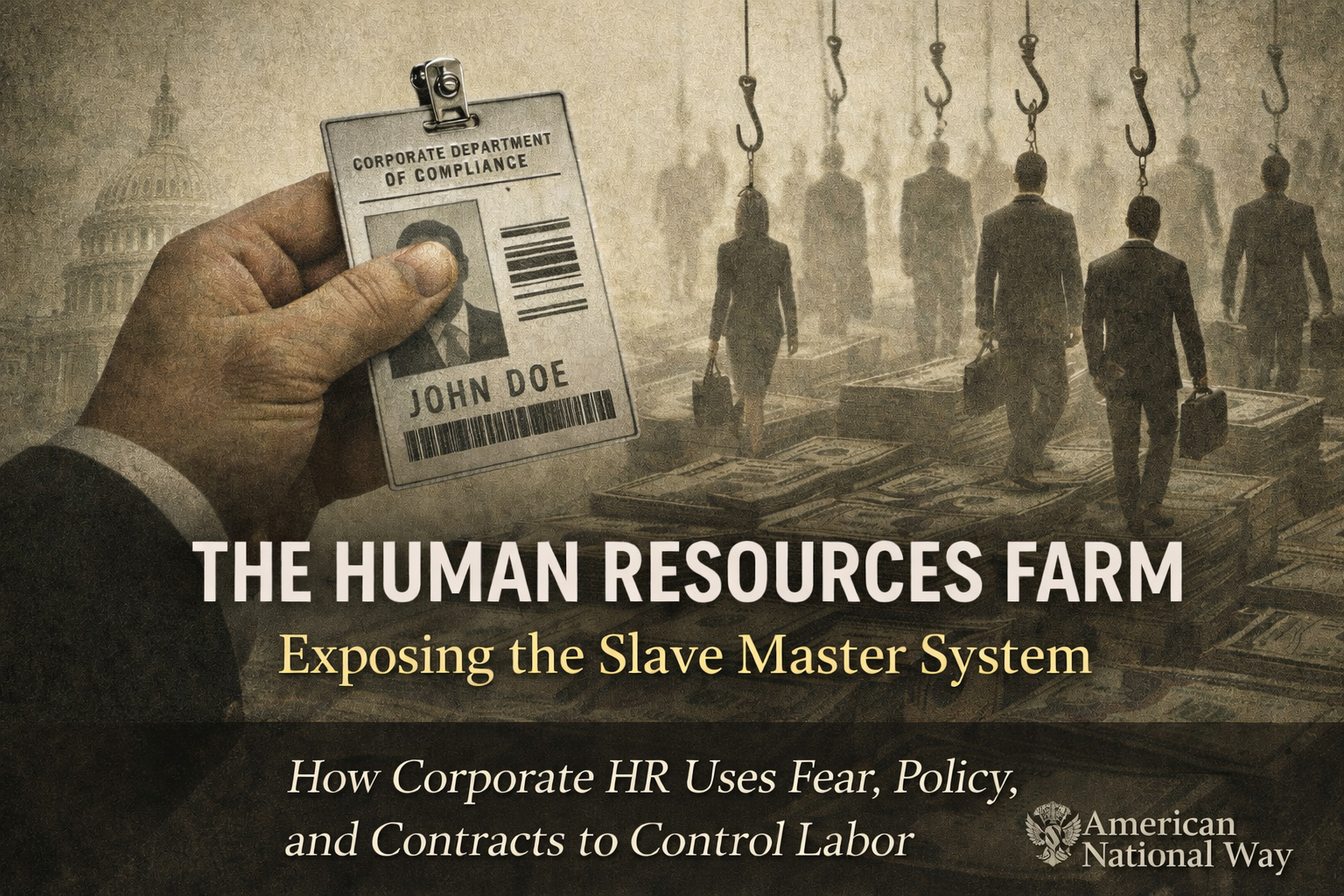
An educational, analytical exposé on how modern HR systems function as compliance engines inside corporate governance.
🧬 From Mankind Beings to “Human Resources”
Language reveals intent. The term Human Resources quietly reframes living men and women as inputs—resources—to be allocated, optimized, and replaced. This linguistic shift is not cosmetic; it is structural. Once labor is reduced to a resource, governance follows rules of procedure, policy, and contract, not conscience or natural law.
HR does not exist to protect people. It exists to protect the organization’s legal position.
🏭 The Corporate Plantation Model
Modern employment mirrors a plantation system—sanitized, bureaucratic, and contractual.
- The organization owns the process
- The policy replaces judgment
- The contract replaces consent through adhesion
Participation is framed as voluntary, yet structured so that refusal means loss of livelihood. This is governance by economic coercion, not moral authority.
What does “The contract replaces consent through adhesion” mean?
🗺️ Corporate Plantation System Map
Local HR → State HR → Federal HR → UN‑Aligned Standards
Each layer functions as a compliance relay:
- Local HR enforces internal policy and discipline
- State HR offices supply regulatory frameworks and labor codes
- Federal HR structures standardize rules across jurisdictions
- International bodies and global standards influence policy harmonization worldwide
The result is vertical integration of workforce control—consistent rules, centralized enforcement, minimal accountability.
⚖️ Policy Is Not Law
Most HR “rules” are not laws passed by legislatures. They are:
- Codes of conduct
- Internal policies
- Regulatory guidance
- Contractual terms
They operate under color of law—appearing authoritative while relying entirely on assumed consent.
When you sign:
- An employment agreement
- A handbook acknowledgment
- A policy update
You are consenting to a private governance system.
🧠 The Fear Funnel
HR compliance is achieved through a predictable psychological sequence:
1️⃣ Benefits
Healthcare, retirement plans, paid time off—presented as gifts, not conditional privileges.
2️⃣ Threats
Discipline, demotion, termination, loss of access—implicitly or explicitly stated.
3️⃣ Compliance
Silence, obedience, self‑censorship, and internalized control.
Fear becomes the enforcement mechanism.
🧾 Contracts Over Conscience
Employment is governed primarily by procedural frameworks—rules that prioritize predictability, liability management, and risk mitigation.
These systems often override:
- Moral discretion
- Individual context
- Natural equity
HR professionals frequently operate in good faith yet are structurally bound to serve the system, not the living soul.
🛑 “Support” Departments That Do Not Advocate
A critical misconception:
HR does not represent you.
HR represents:
- The corporation
- The institutional entity
- The legal person
This is not malice; it is design.
🚪 Remedies: Regaining Agency Without Illusion
This article is not a call to anger, rebellion, or revenge. It is a call to clarity.
Practical steps:
- Read every agreement as a commercial contract
- Distinguish policy from law
- Withhold assumptions of consent
- Negotiate when possible—or consciously decline
- Build skills and livelihoods that reduce dependence on institutional employment
Awareness is the first exit.
🕊️ Closing: Seeing the System Clearly
When men and women understand the structure, the fear weakens.
Human Resources is not evil.
It is mechanical.
And mechanical systems persist only while they remain unseen.
This article is educational and analytical. It encourages critical thinking, lawful self‑governance, and peaceful disengagement from systems that no longer serve mankind dignity.
✍️ Editorial Note: The Immutable Nature of HR
Human Resources will never change—not because the people within it refuse, but because it was designed to function exactly this way. HR, like the broader legal system, treats people as fictitious entities, commodities governed by contracts, policy, and commercial procedure.
The system is intentionally structured to extract labor, enforce compliance, and maintain order—its design is immutable, and understanding this is the first step toward true freedom.
Google AI Overview
The term “human resources” and HR practices can be dehumanizing by treating employees as mere assets or cogs in a machine, rather than individuals with unique needs, leading to objectification, reduced empathy, and prioritizing efficiency over well-being.
This feeling stems from language (like “resources”), rigid processes (like applicant tracking systems), and a focus on metrics over people, making workers feel like interchangeable tools, but can be countered by human-centric leadership and valuing personal growth.
How it manifests
- Language: Calling people “resources” reduces them to commodities, removing the “human” aspect and emotional weight, according to Quora users and Psychology Today.
- Objectification: Feeling like a “cog in a machine,” an “instrument for the organization’s ends,” or just a number, especially when reduced to performance metrics or data points, as discussed in articles on Medium and Wiley Online Library.
- Process over People: Over-reliance on rigid, impersonal systems (like Applicant Tracking Systems or strict rules) that create a poor experience and disregard individual needs, notes Medium.
- Focus on Output: Prioritizing profitability and operational efficiency above the employee’s well-being, aspirations, and personal life.
Solutions and counter-measures
- Leadership: Leaders showing empathy, asking questions, and recognizing employees as individuals with lives outside work.
- Human-Centric Language: Using terms like “human capital“ or shifting focus to “human resourcefulness,” suggest Psychology Today.
- Growth Opportunities: Investing in employee development through training and mentorship shows they are valued long-term, according to Fringe.
- Communication: Fostering open dialogue, teamwork, and recognition, say Terryberry, and ensuring HR policies are reviewed for fairness and alignment with human values.
The Dehumanization of Human Resources — Part One
Human Resources Products and Services — Washington, DC, 20415