


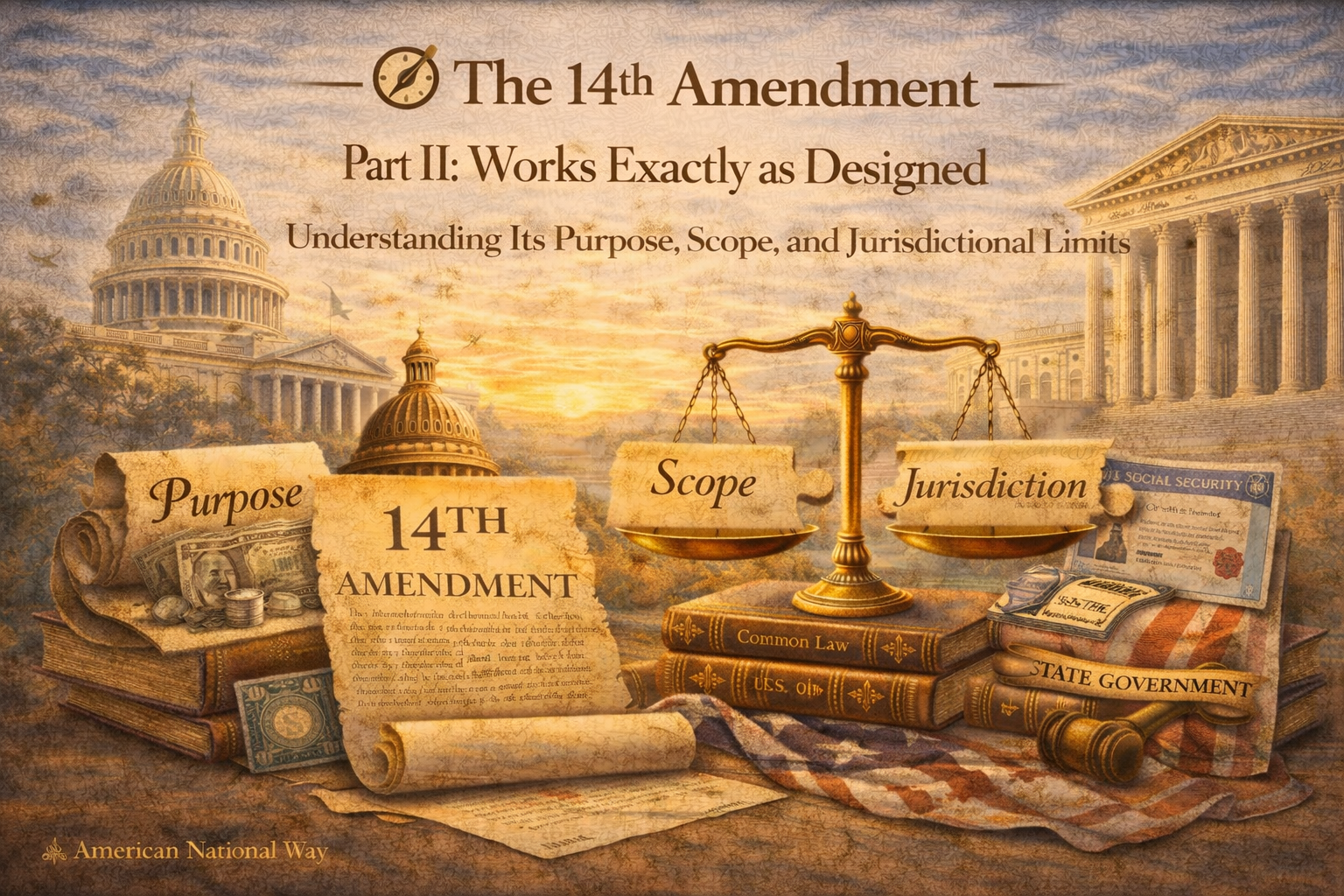
The 14th Amendment is often framed as a moral promise that took generations to fulfill.
Another way to understand it — a clearer and more accurate way — is this:
The 14th Amendment works exactly as it was designed to work.
Not as a declaration of inherent rights, but as a jurisdictional operating system for a post‑Civil War nation.
This article does not condemn the amendment, nor does it glorify it. It explains its function, its limits, and why so much confusion exists around its role.
⚖️ Design Begins With Purpose
The 14th Amendment was ratified in 1868 during Reconstruction.
Its purpose was not philosophical. It was administrative and political:
- Restore governance after the Civil War
- Bring formerly excluded populations under federal protection
- Subordinate state law to federal authority
- Stabilize debt, representation, and office‑holding
In short, it was meant to consolidate national jurisdiction.
Judged by that standard, it succeeded.
🪪 Citizenship as a Legal Status
The amendment defines a specific legal identity:
Citizens of the United States, subject to the jurisdiction thereof.
This is not a poetic phrase. It is a technical one.
Citizenship here is:
- Federally defined
- Statutorily governed
- Jurisdictionally bound
Once a person operates in this capacity, the rest of the amendment activates automatically.
This is why the 14th Amendment is so powerful — and so misunderstood.
🛡️ Equal Protection as Internal Regulation
Equal Protection does exactly what it says:
It requires equal treatment within the system.
It does not:
- Question whether the system itself is just
- Prohibit classification
- Prevent regulation
This explains a historical fact many find uncomfortable:
- Segregation existed within equal protection
- Discrimination survived inside the framework
- Justice depended on later reinterpretation
This is not failure.
This is scope.
📜 Due Process: How, Not Whether
Due Process is often mistaken for a shield against government action.
It is not.
It is a rulebook governing how government may act after jurisdiction is established.
The state may deprive life, liberty, or property — provided it follows procedure.
Again, the amendment works exactly as designed.
🧠 Why the Amendment Is So Heavily Litigated
The 14th Amendment is the most litigated amendment because:
- It governs daily interaction between people and government
- It manages benefits, status, regulation, and compliance
- It is activated by participation
The courts did not “expand” the amendment.
They operated it.
🧬 Not Moral Failure — Category Confusion
Much frustration surrounding the 14th Amendment comes from a simple mistake:
Treating a statutory framework as a statement of natural rights.
Once that mistake is corrected, clarity follows:
- The amendment regulates citizens
- It restrains states
- It standardizes governance
It was never meant to define the full scope of Mankind Freedom.
✍️ Participation Is the Switch
The 14th Amendment does not chase anyone.
It activates when a person:
- Claims benefits
- Seeks protection
- Petitions authority
- Accepts status
Participation supplies jurisdiction.
From there, the machine runs.
🧠 The Real Insight
Understanding the 14th Amendment does not require outrage.
It requires precision.
When you know who it applies to and why, the confusion ends.
The amendment is not broken.
It is doing exactly what it was designed to do.
📌 Editorial Note
What Google AI provided below is the strongest mainstream form of 14th Amendment, it is the official, orthodox explanation taught in schools, courts, and civic literature.
The most effective way is to place this narrative in its proper category and then show where it silently makes assumptions.
🧩 Google AI Overview
The 14th Amendment, ratified in 1868, is a cornerstone of U.S. civil rights, granting citizenship to all persons born or naturalized in the U.S. (including former slaves). It guarantees all citizens “equal protection of the laws” and “due process of law” at the state level, significantly expanding federal protections against state actions and influencing landmark cases like Brown v. Board of Education. It also addresses apportionment, disqualifies insurrectionists from office, and invalidates Confederate debt.
Key Provisions of Section 1:
- Citizenship Clause: Defines U.S. citizenship for everyone born or naturalized in the country.
- Privileges or Immunities Clause: Prevents states from infringing on citizens’ privileges and immunities.
- Due Process Clause: Prohibits states from depriving any person of life, liberty, or property without due process of law (incorporating the 5th Amendment’s protections).
- Equal Protection Clause: Mandates that states provide equal protection of the laws to all people within their jurisdiction, a crucial basis for civil rights.
Other Important Sections:
- Section 2: Addresses representation in Congress based on population, penalizing states that deny voting rights.
- Section 3 (Insurrection Clause): Bars individuals who engaged in rebellion against the U.S. from holding office.
- Section 4: Validates U.S. public debt, but invalidates Confederate debts.
Significance:
- Reconstruction Era: Enacted after the Civil War to secure rights for newly freed slaves.
- Incorporation Doctrine: Used to apply most of the Bill of Rights to the states.
- Foundation for Civil Rights: The most litigated amendment, forming the legal basis for desegregation, voting rights, and other key civil liberties.
Source: https://www.google.com/search?q=The+14th+Amendment
📘 The Orthodox 14th Amendment Narrative
Here is a calm clarification, not a confrontation.
Everything Google AI provided is accurate within the federal statutory framework:
- The 14th Amendment does define U.S. citizenship
- It does constrain state action
- It has been used in landmark cases (Brown, incorporation, voting rights)
- It is the most litigated amendment
- It did reshape Reconstruction governance
- Sections 2–4 do address representation, insurrection, and debt
Nothing here is false.
The key issue is not accuracy — it is scope.
⚠️ The Silent Assumption Behind This Narrative
The entire explanation rests on one unspoken premise:
That the individual is operating as a U.S. Citizen within federal statutory jurisdiction.
Once that premise is accepted, everything follows logically and cleanly.
In other words:
- ✔️ The 14th Amendment works
- ✔️ The courts apply it consistently
- ✔️ Federal protections expand accordingly
For those inside that legal capacity.
This is the point most discussions never make explicit.
🔄 Two Layers of Operations With No Contradictions
Layer 1 — Civic / Statutory Facts (The Narrative)
- Addresses persons, citizens, and jurisdiction
- Presumes participation
- Presumes benefit-seeking
- Presumes federal supremacy over states
- Correct inside the system
Layer 2 — Structural / Jurisdictional Facts (Lawful Way)
- Asks who consented
- Asks how status was assigned
- Asks what kind of citizenship this is
- Asks whether rights are inherent or conditional
Both layers can exist simultaneously without contradiction.
The confusion arises when Layer 1 is presented as universal reality, rather than conditional applicability.
🏛️ Section 1 Reframed (Without Distortion)
Here is the key clarification:
- Citizenship Clause
✔ Defines U.S. citizenship
⚠ Does not define man or woman
⚠ Ties status to jurisdiction - Privileges or Immunities Clause
✔ Applies to citizens
⚠ Does not enumerate inherent rights
⚠ Narrowed almost immediately by courts - Due Process Clause
✔ Regulates how deprivation occurs
⚠ Does not prohibit deprivation
⚠ Operates after jurisdiction is established - Equal Protection Clause
✔ Requires equal treatment within the system
⚠ Does not prevent unjust systems from existing
⚠ Depends entirely on interpretation and enforcement
There is nothing wrong in the system, it simply works as intended.
🧭 One Core Clarification is Needed
The missing sentence in nearly every textbook explanation is this:
The 14th Amendment governs those who accept or operate under U.S. citizenship and its attached jurisdiction.
Once that sentence is added:
- There is no deception
- There is no confusion
- There is no contradiction
Only choice and understanding.
🔚 Final Reflection
A system can function perfectly and still not be universal.
The key is knowing when you are inside it — and when you are not.