🧱 Offline Computing and the Illusion of Cybersecurity

🧠 A Necessary Premise
The internet has been marketed as a miracle of modern life—connection, knowledge, convenience. Yet beneath this surface lies an uncomfortable truth:
The internet is not a neutral tool. It is an engineered control environment.
It was never designed for sovereignty, privacy, or dignity. It was designed for connectivity, dependency, and monitoring.
This article does not argue against technology. It argues for using technology honorably, without surrendering one’s life, family, or mind to a permanently surveilled binary system.
🧲 The Digital Handcuffs We Mistake for Convenience
Email accounts. Online logins. Smartphones. Cloud services. Always-on routers. Continuous WAN connections.
These are not requirements for living, learning, or sharing knowledge. They are attachment points.
Every always-online device:
- Broadcasts identity and behavior
- Creates metadata trails
- Requires consent through Terms, Accounts, and Policies
- Places the user inside a foreign jurisdiction they do not control
The result is a population trained to believe that life cannot function without permanent digital permission.
That belief is false.
⚙️ The Fundamental Technical Reality (Often Avoided)
As long as a computer or router is:
- Programmed with TCP/IP and Ethernet stacks, and
- Connected to the Internet / WAN
There is:
❌ Zero true security
❌ Zero privacy
❌ Zero integrity
This is not opinion. It is architecture.
Firewalls, VPNs, encryption, and cybersecurity certifications do not change the underlying reality. They only add friction—not sovereignty.
Cybersecurity only exists as a study because the system itself is insecure by design.
Remove the WAN connection—and suddenly:
- Surveillance collapses
- External attack surfaces disappear
- Digital consent is withdrawn
The greatest security measure is not connecting in the first place.
🛡️ What Offline Computing Actually Means
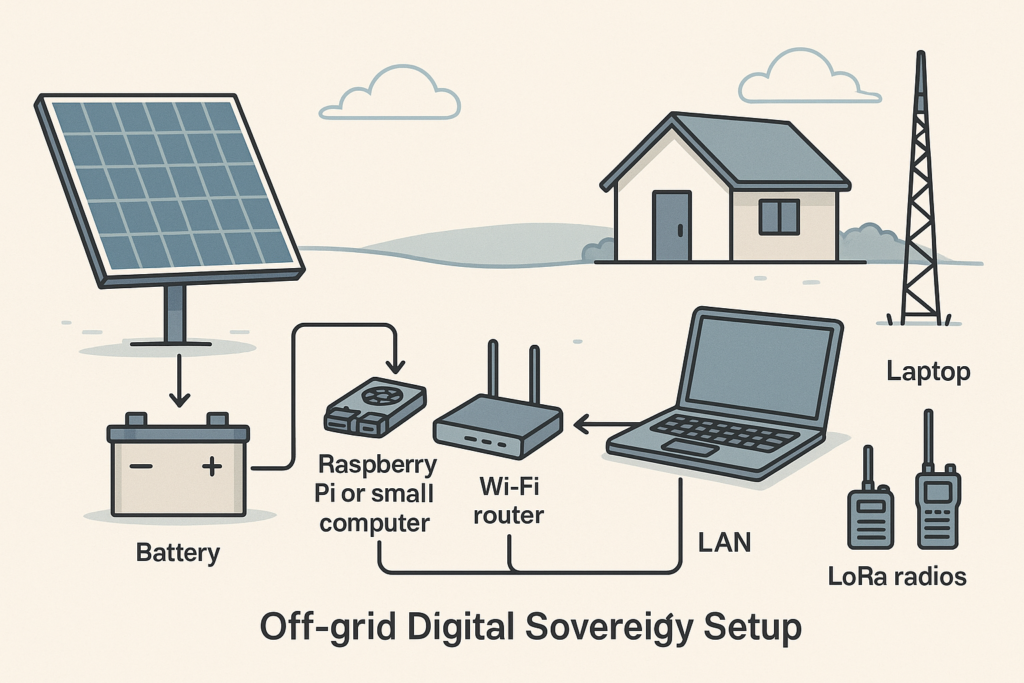
Offline or off-grid living does not mean rejecting computers or networks.
It means:
- Using Local Area Networks (LAN) instead of the Internet
- Using offline servers instead of cloud platforms
- Using stored knowledge instead of streamed knowledge
- Using mankind trust instead of digital identity
A household, farm, or homeschool can operate fully with:
- Ethernet switches and Wi-Fi routers without WAN ports connected
- Computers sharing files locally
- Printers, media servers, and libraries operating in isolation
This is not regression. It is containment.
📚 Knowledge Does Not Require the Internet
The idea that learning requires internet access is one of the most damaging modern lies.
Tools like:
- KiWix (offline Wikipedia, books, manuals)
- Kolibri (offline education & homeschooling)
- PDFs, eBooks, and local archives
Allow entire families and communities to learn without being tracked, profiled, or shaped by algorithms.
Historically, knowledge traveled by:
- Scrolls
- Books
- Letters
- Teachers
Not by push notifications.
🏡 Offline Computing Is Ideal for Families & Education
For families, children, and homeschooling environments:
- Offline computing protects innocence
- Focus replaces addiction
- Learning becomes intentional
No ads.
No manipulation.
No algorithmic conditioning.
Children grow up learning how to think, not how to scroll.
🏢 Online Computing Belongs to Business — Not to Life
There is a distinction that must be restored:
- Online computing is suited for businesses that accept contracts, risk, exposure, and corporate jurisdiction
- Offline computing is suited for life, family, learning, and sovereignty
When business tools invade private life, the result is enslavement—not efficiency.
🔌 A Simple Rule for the Digital Age
If it must be always connected, it is not yours.
True ownership requires the ability to disconnect.
🧭 Final Reflection
You do not need:
- Email accounts
- Online profiles
- Smartphones
- Continuous internet access
To be informed, educated, connected, or honorable.
You need:
- Discipline
- Local networks
- Physical knowledge
- Community
- Restraint
The most powerful act in the digital age is not resistance.
It is withdrawal of consent.
Offline computing is not anti-technology.
It is pro-dignity, pro-family, and pro-sovereignty.