


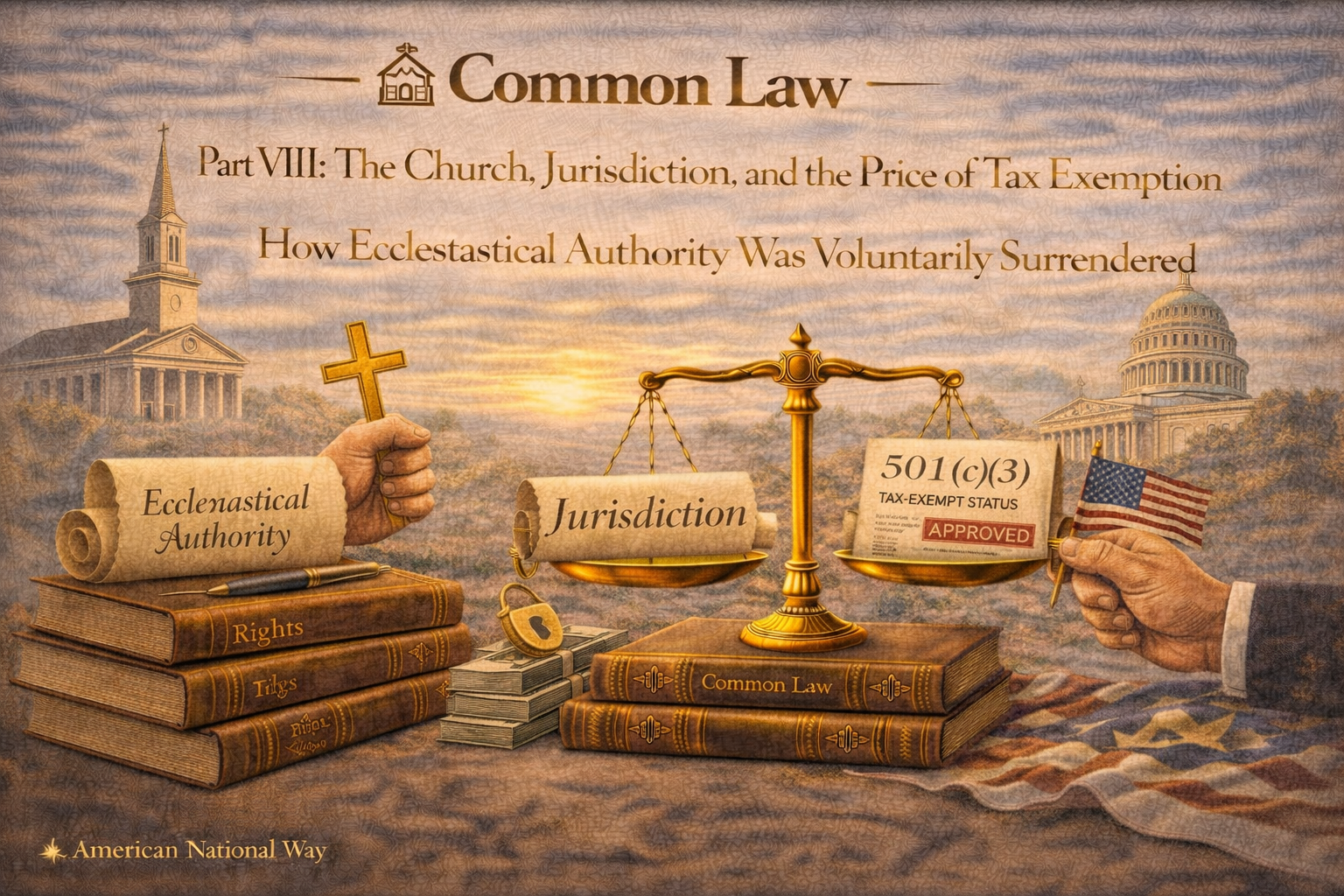
This article is part of a structured series based on the work of John Quade. Each installment builds on the previous one. If you’re new here, I strongly recommend starting with the Series Introduction, which explains the purpose, scope, and proper way to read this work.
🛡️ The Forgotten Shield
For much of Western history, the church functioned as more than a place of worship.
It was a jurisdiction.
Its grounds were protected.
Its authority was recognized.
Its members stood under a separate government — ecclesiastical law.
John Quade reminds his audience that this was not symbolic.
It was enforceable.
📜 What Is Ecclesiastical Jurisdiction?
Ecclesiastical jurisdiction refers to the authority of the church to govern its internal affairs — including doctrine, discipline, and protection of its members — without interference from civil power.
Historically, this meant:
- Church property was inviolable
- Civil authorities hesitated to cross its boundaries
- Members enjoyed a form of legal shelter under church authority
This was not immunity from justice.
It was separation of jurisdictions.
🌍 A Power Even Armies Respected
Quade offers a striking example from modern history.
When Manuel Noriega sought refuge, he did not hide behind soldiers or weapons.
He entered a church.
Why?
Because even the most powerful military forces recognized the danger of violating ecclesiastical jurisdiction.
The boundary mattered.
🇺🇸 How It Once Worked in America
Until the early 20th century, American churches retained this same authority.
Church grounds were sacred.
More importantly:
Members of the church were protected by the church’s jurisdiction.
This carried real consequences:
- Protection of property
- Recognition of moral law
- Resistance to arbitrary civil intrusion
Quade argues this protection was deeply connected to common law.
💰 The Offer That Changed Everything
The shift did not come through persecution.
It came through an offer.
Tax exemption.
Under the modern 501(c)(3) framework, churches were invited to register as non-profit corporations.
The promise was simple:
- Relief from taxation
- Administrative ease
- Institutional security
The cost was rarely disclosed.
⚠️ What Was Surrendered
By accepting corporate status, Quade argues, churches:
- Voluntarily entered civil jurisdiction
- Surrendered independent authority
- Accepted conditions on speech and action
Ecclesiastical jurisdiction did not vanish.
It was signed away.
🧠 Why This Matters to Ordinary People
This was not merely an institutional decision.
When churches surrendered jurisdiction:
- Members lost a layer of protection
- Moral law lost a public defender
- Civil authority expanded unchecked
Quade’s critique is sharp:
The church removed itself from the battlefield — and left the people exposed.
🔄 From Authority to Accommodation
Once jurisdiction was surrendered, churches adapted.
They became:
- Program-oriented
- Tax-compliant
- Politically cautious
Law was avoided.
Responsibility was softened.
Grace was detached from obedience.
Quade sees this as a catastrophic misunderstanding — not of politics, but of faith.
🩸 Why the Price Was Too High
Without an independent moral authority, civil power faces no counterbalance.
The result is predictable:
- Expansion of regulation
- Erosion of conscience
- Loss of self-governance
Quade does not argue that churches should seek power.
He argues they once exercised responsibility — and abandoned it.
🧱 What Comes Next— Transition to Part IX
If the church surrendered its jurisdiction voluntarily, then one question becomes unavoidable:
Who will bear the cost of liberty when institutions no longer will?
That question leads to sacrifice, history, and blood.
— Next: Part IX — Blood, Sacrifice, and the True Cost of Liberty