


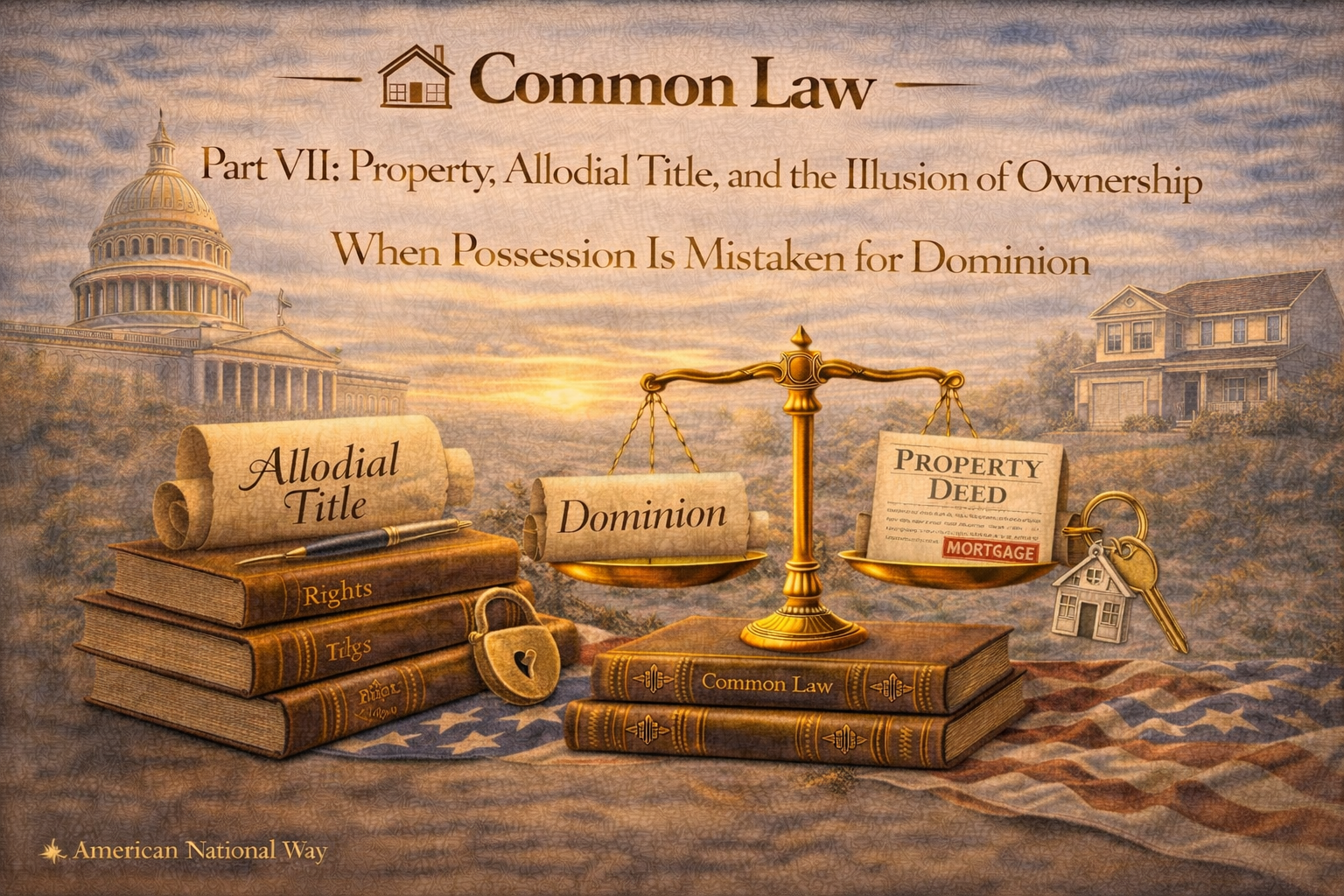
This article is part of a structured series based on the work of John Quade. Each installment builds on the previous one. If you’re new here, I strongly recommend starting with the Series Introduction, which explains the purpose, scope, and proper way to read this work.
🧱 The Question Everyone Assumes Is Settled
Most people believe they understand property.
They paid for it.
They maintain it.
They insure it.
They defend it.
So the question seems absurd:
Do you actually own what you call “your property”?
John Quade insists this question is not philosophical — it is legal.
📜 Ownership vs. Tenure
Historically, ownership implied dominion:
- Control without superior
- Possession without condition
- Use without permission
This form of ownership was known as allodial title.
Allodial title meant property was held absolutely, owing no duty, fee, or service to any higher authority.
By contrast, tenure means property is held:
- Conditionally
- Subject to obligations
- At the pleasure of a superior
Quade argues that most modern “ownership” resembles tenure — not allodial dominion.
📘 What Is Allodial Title?
Black’s Law Dictionary defines allodial.
In plain terms, it means:
Property held in one’s own absolute right, without obligation to any lord or superior.
In early America, this concept mattered deeply.
It is why:
- A man’s home was his castle
- Property could not be arbitrarily seized
- Government power stopped at the threshold
🏛️ How America Changed the Old World Model
In Europe:
- Only kings held allodial title
- Everyone else paid feudal duties
After independence, Congress passed multiple acts guaranteeing allodial title to ordinary men and women.
This was revolutionary.
It placed citizens on equal legal footing with monarchs.
Quade argues this was not symbolic — it was structural.
💰 The Taxation Test
Quade offers a blunt diagnostic:
If you pay recurring taxes on property, you do not hold it allodially.
Why?
Because taxation implies:
- Ongoing obligation
- Superior authority
- Conditional possession
True ownership cannot be revoked for non-payment of rent.
Yet modern property can be seized for unpaid taxes — even if fully “paid off.”
This reveals the underlying relationship.
🏷️ Title vs. Certificate of Title
Here, Quade exposes a subtle but powerful distinction.
A title is ownership.
A certificate of title is evidence issued by an authority acknowledging registration.
They are not the same.
When property is registered:
- Ownership is converted into record
- Record is held by the state
- Compliance becomes the condition
The certificate looks like ownership — but functions as surety.
🧠 Why This Feels Normal
Most people never question property status because:
- The system is inherited
- Alternatives are not discussed
- Complexity discourages inquiry
Quade notes that normalization is the most effective form of control.
What is never questioned never has to justify itself.
⚠️ When Ownership Is Tested
The illusion only breaks when:
- Taxes go unpaid
- Codes are violated
- Permits are denied
- Liens are imposed
At that moment, “ownership” reveals its conditions.
Quade’s argument is not sentimental:
Property that can be seized without crime is not truly owned.
🔄 Property as Leverage
Under administrative systems, property serves another function:
It becomes leverage.
Taxes, fees, and compliance obligations ensure behavior — not justice.
Property, once a shield, becomes a handle.
🩸 Why This Matters
Property is the material foundation of liberty.
Without secure ownership:
- Independence erodes
- Families destabilize
- Communities weaken
Quade warns that a people who do not control their property cannot meaningfully govern themselves.
🧱 What Comes Next
If property once stood protected by higher authority, then the next question follows:
What role did the church once play in shielding people from state power — and what happened to that protection?
— Next: Part VIII — The Church, Jurisdiction, and the Price of Tax Exemption