


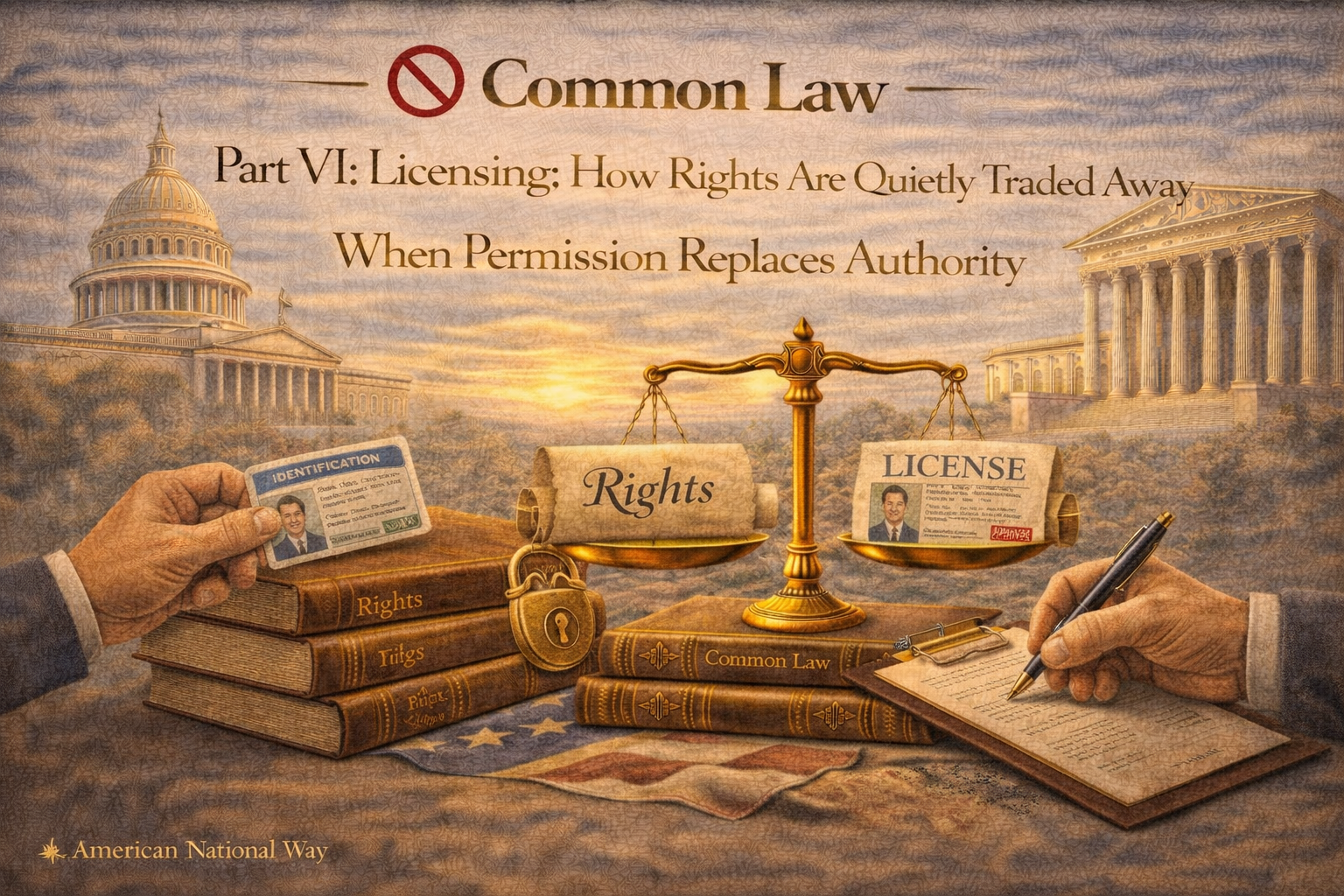
This article is part of a structured series based on the work of John Quade. Each installment builds on the previous one. If you’re new here, I strongly recommend starting with the Series Introduction, which explains the purpose, scope, and proper way to read this work.
🔑 The Price of Permission
One of John Quade’s most unsettling observations is also one of the simplest:
Every time you accept a license, you surrender a right.
Licenses are presented as conveniences — even protections. They appear neutral, administrative, and necessary for modern life.
But at law, a license has a precise meaning:
A license is permission to do something that would otherwise be illegal without that permission.
This definition changes everything.
📜 Rights Do Not Require Permission
A right, by its nature:
- Exists without approval
- Cannot be lawfully prohibited
- Does not need regulation to exist
Once permission is required, the activity is no longer treated as a right — it has been reclassified.
Quade’s contention is not that all regulation is evil, but that classification precedes control.
🚗 Driving vs. Traveling
Quade uses one of the most common examples:
Driving.
Modern people are taught that operating a vehicle is a privilege.
Historically, however:
- Travel was understood as a right
- Driving for hire or commerce was regulated
Licensing did not govern movement — it governed commercial activity.
The quiet shift occurred when everyday travel was redefined as a regulated activity.
Once licensed, the individual no longer moves by right — but by permission.
💍 Marriage: Covenant or Contract?
Marriage provides another example.
Historically:
- Marriage existed as a covenant
- The community and church bore witness
- No state permission was required
The introduction of marriage licenses altered that relationship.
By applying for a license:
- The state becomes a third party
- Jurisdiction is established
- Terms are imposed by statute
Quade points to court decisions recognizing this shift, arguing that many consequences of family law flow directly from that initial consent.
🏠 Property and the Illusion of Ownership
Licensing logic extends to property.
When property is:
- Registered
- Titled
- Taxed annually
It begins to resemble a conditional grant rather than absolute ownership.
Quade frames it starkly:
If you pay ongoing fees for something, you do not fully own it.
Licenses and registrations convert possession into compliance.
🧠 Why People Accept Licenses
Licenses succeed not because people are malicious — but because they are practical.
Licenses offer:
- Convenience
- Uniformity
- Access
- Predictability
What they quietly remove is independence.
The trade seems reasonable — until enforcement appears.
⚠️ Enforcement Reveals the Truth
When terms are violated:
- Permission is revoked
- Penalties apply
- Property is seized
- Activities are prohibited
At that moment, the individual discovers the true nature of the relationship.
Quade’s argument is not emotional — it is diagnostic:
Enforcement exposes whether you were acting by right or by license.
🔄 From Self-Governance to Supervision
Licensing shifts society from:
- Self-governance
- Moral accountability
To:
- External supervision
- Administrative control
The more licenses required, the fewer rights remain recognizable.
🩸 Why This Matters
A population trained to ask permission for ordinary acts will eventually forget what authority feels like.
Quade warns that liberty does not vanish overnight — it is regulated out of existence.
🧱 What Comes Next
If licensing converts rights into privileges, then the next question follows naturally:
What happens to property under such a system?
Ownership.
Title.
Taxation.
— Next: Part VII: Property, Allodial Title, and the Illusion of Ownership