


This article is part of a structured series based on the work of John Quade. Each installment builds on the previous one. If you’re new here, I strongly recommend starting with the Series Introduction, which explains the purpose, scope, and proper way to read this work.
🔔 Why This Part Matters
If modern law functions as a religion (Part IV), then the obvious question follows:
What law did it replace?
John Quade’s answer is calm, historical, and precise:
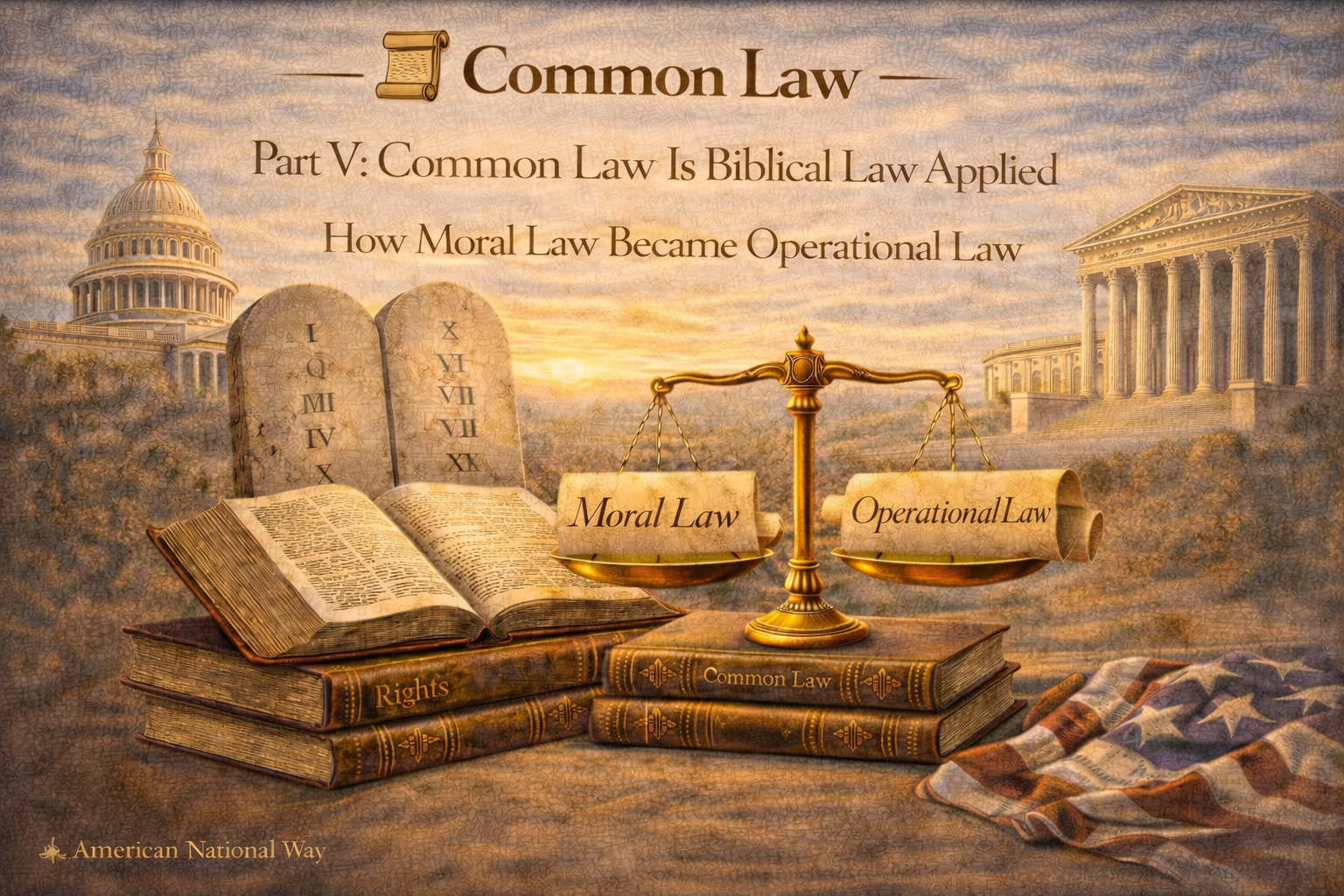
Common Law is biblical law applied to daily life.
Not theology by coercion.
Not church rule over state.
But moral principles made operational.
🧱 Law Before Legislatures
Long before codes, statutes, or parliaments, societies governed themselves by recognized moral boundaries, not written permission slips.
Nearly all cultures shared the same core prohibitions:
- Do not murder
- Do not steal
- Do not bear false witness
- Honor agreements
- Repair harm you cause
Biblical law did not invent these rules.
It recorded and preserved them.
📖 Scripture as a Legal Record
Modern readers treat the Bible as religious literature only.
Historically, it also functioned as a legal reference.
Within it we find:
- Restitution for theft
- Accountability for injury
- Standards for testimony
- Limits on rulers
- Equality before judgment
These principles later reappear — almost word for word — in common-law maxims.
That is not coincidence.
It is inheritance.
⚖️ What Common Law Actually Is
Common law is not legislation.
It is law discovered, not written.
Its defining characteristics:
- A harmed party must exist
- Injury must be proven
- Intent matters
- Truth is a defense
- No victim → no crime
These are moral standards — not administrative conveniences.
🧠 Justice vs. Compliance
Biblical law is concerned with justice.
Statutory law is concerned with compliance.
This distinction explains almost everything.
Under common law:
- Harm must be demonstrated
- Restitution restores balance
- Punishment is proportional
Under statutory systems:
- Violation alone is sufficient
- Penalties are predefined
- Revenue replaces repair
John Quade emphasized this shift as the turning point where law stopped serving people and began managing them.
🕊️ Moral Authority Comes First
Common law assumes something modern systems no longer require:
A people capable of self-restraint.
Law existed as a boundary — not a babysitter.
Authority rested first with conscience, not enforcement.
This is why:
- Juries mattered
- Communities mattered
- Reputation mattered
Force was the exception — never the foundation.
⛪ Church, Community, and Justice
Historically, roles were distinct but aligned:
- Churches formed conscience
- Communities enforced standards
- Courts resolved disputes
When moral education weakened, law expanded.
Statute grows where conscience disappears.
⚠️ What Happens When Biblical Law Is Abandoned
When law is severed from moral foundations:
- Acts become crimes without victims
- Obedience replaces righteousness
- Surveillance replaces trust
- Authority expands endlessly
John Quade’s warning is sharp:
Law without morality requires force to survive.
🧭 Standing Is Essential
Common law only functions among:
- Living men and women
- Communities capable of self-governance
- People accountable to higher authority
It cannot operate among legal fictions.
Persons require statutes.
Men and women require conscience.
🧱 Why This Part Locks the Series Together
This piece connects:
- Rights → their source
- Law → belief
- Church → jurisdiction
- Status → capacity
- Liberty → responsibility
It explains why the founders leaned on common law —and why an administrative system had to replace it.
🔚 Closing Reflection
Common law was not abandoned because it failed.
It was abandoned because it required moral adults.
Biblical law applied demands:
- Responsibility
- Truth
- Restraint
Statutory systems demand only participation.
John Quade’s conclusion was never political:
A people unwilling to govern themselves will always be governed by statute.
🧱 What Comes Next
If status is defined through participation — and participation is normalized through licensing — then the next issue becomes unavoidable:
What do licenses actually do at law?
Marriage.
Driving.
Property.
— Next: Part VI: Licensing: How Rights Are Traded Away