


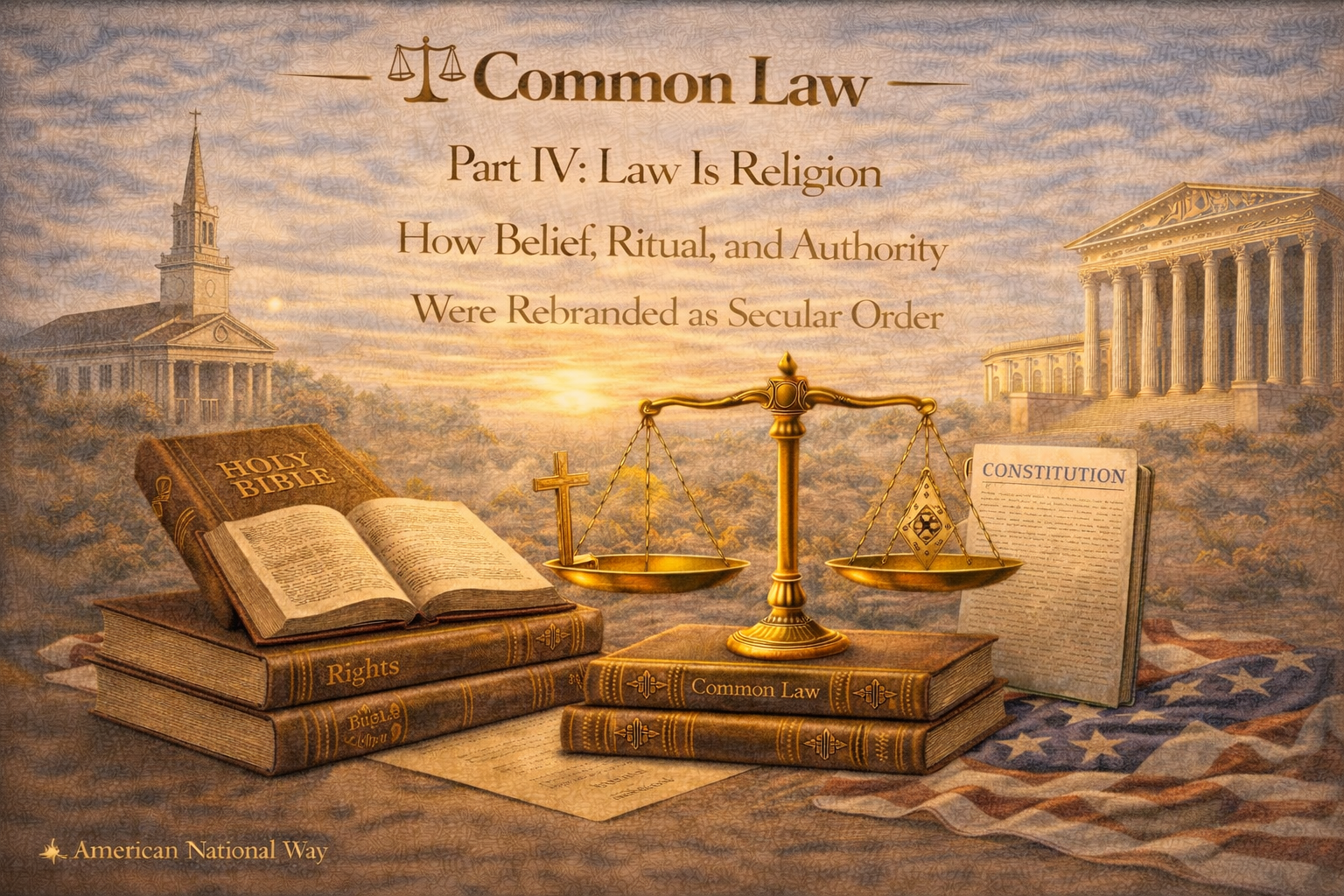
This article is part of a structured series based on the work of John Quade. Each installment builds on the previous one. If you’re new here, I strongly recommend starting with the Series Introduction, which explains the purpose, scope, and proper way to read this work.
🔔 Why This Part Cannot Be Skipped
Up to this point, the series has examined rights, consent, status, contracts, and jurisdiction.
But John Quade understood something deeper, something rarely spoken aloud:
Modern law does not merely govern behavior — it commands belief.
In structure, function, and practice, law now operates as a religion.
Not symbolically.
Not rhetorically.
But operationally.
🧠 What Defines a Religion?
Remove icons and incense, and religion reduces to a few core elements:
- A supreme authority
- A belief system explaining order
- Rituals of participation
- An ordained interpreting class
- Rules of obedience
- Guilt, confession, and absolution
- Punishment for violation
- Promises of protection
Modern legal systems contain every one of these components.
📜 The New Supreme Authority
In traditional societies, ultimate authority rested in God or moral law.
In modern society, that authority rests in Law itself.
Not natural law.
Not common law.
But statutory and administrative law.
It declares:
- What is permitted
- What is forbidden
- What must be done
- What will be punished
And most importantly:
It requires belief in its legitimacy to function.
👥 The Priesthood of Law
Every religion has interpreters.
In the legal religion, they are:
- Judges
- Attorneys
- Clerks
- Administrators
They speak a specialized language inaccessible to lay people.
They wear symbolic attire.
They interpret doctrine rather than create truth.
Like clergy, they function as mediators between the individual and authority.
🕯️ Rituals and Sacraments
Participation in the legal system requires ritual:
- Swearing oaths
- Signing documents
- Standing when addressed
- Entering pleas
- Filing forms
- Using prescribed phrases
These acts are not merely procedural.
They are ritual confirmations of belief and submission.
Without ritual, recognition is denied.
🧾 Sin, Guilt, and Confession
Every religion has sin.
In the legal religion:
- “Violations” replace sin
- Citations replace confession
- Pleas replace repentance
- Fines replace penance
Once jurisdiction is accepted, guilt is presumed.
Absolution is purchased through:
- Compliance
- Payment
- Punishment
Justice becomes transactional.
💰 Tithes, Offerings, and Sacrifice
Religious systems require offerings.
So does the legal system:
- Taxes
- Fees
- Fines
- Licenses
- Court costs
These payments sustain the institution.
They are not optional contributions — they are mandatory tithes for continued recognition.
🏛️ Temples of Authority
Courthouses function as temples.
They are:
- Architecturally elevated
- Symbolically adorned
- Designed to inspire silence and obedience
Behavior shifts the moment one enters.
This is not accidental.
It is ritual conditioning.
🔄 Why People Believe
Religions endure because they offer:
- Order
- Stability
- Predictability
- Safety
The legal religion offers the same exchange:
Obedience in return for protection.
Few questions this bargain — because questioning threatens comfort.
⚠️ When Law Replaces Moral Authority
The danger is not law itself.
The danger is confusing law with righteousness.
When that happens:
- Obedience replaces conscience
- Legality replaces morality
- Permission replaces responsibility
Injustice becomes “lawful.”
Cruelty becomes “procedural.”
Belief suppresses discernment.
🧭 Standing Outside the Religion
John Quade never argued for anarchy.
He argued for clarity.
A man may interact with a religion without worshiping it.
A man may enter a system without surrendering his soul.
But only if he understands what it is.
🧱 Why This Part Matters
Until a man recognizes law as a belief system:
- He will mistake authority for truth
- He will confuse obedience for virtue
- He will assume enforcement equals legitimacy
Seeing the system clearly does not cause chaos.
It breaks the spell.
Quietly.
🧭 Closing Reflection
Law is not evil.
Religion is not evil.
But treating institutions as ultimate authority produces bondage.
John Quade’s warning was simple and restrained:
Do not kneel to systems that demand belief without conscience.
Only then can a man stand both lawfully and freely.
🔚 Transition to Part V
Recognizing that modern law functions as a belief system is an important step — but it raises a necessary follow-up question.
If law now demands belief, ritual, and obedience, then what preceded it? What form of law existed before institutions required compliance rather than conscience?
In the next article, Part V — Common Law Is Biblical Law Applied, we will step back to examine the moral foundation that once governed free people without endless statutes, permissions, or intermediaries.
Not as theology.
Not as dogma.
But as principles of conduct made practical — law rooted in responsibility, accountability, and lived ethics rather than administrative control.
Understanding this origin is essential, because one cannot see what has been replaced unless one understands what came first.