


This article is part of a structured series based on the work of John Quade. Each installment builds on the previous one. If you’re new here, I strongly recommend starting with the Series Introduction, which explains the purpose, scope, and proper way to read this work.
🔍 The Most Important Distinction No One Is Taught
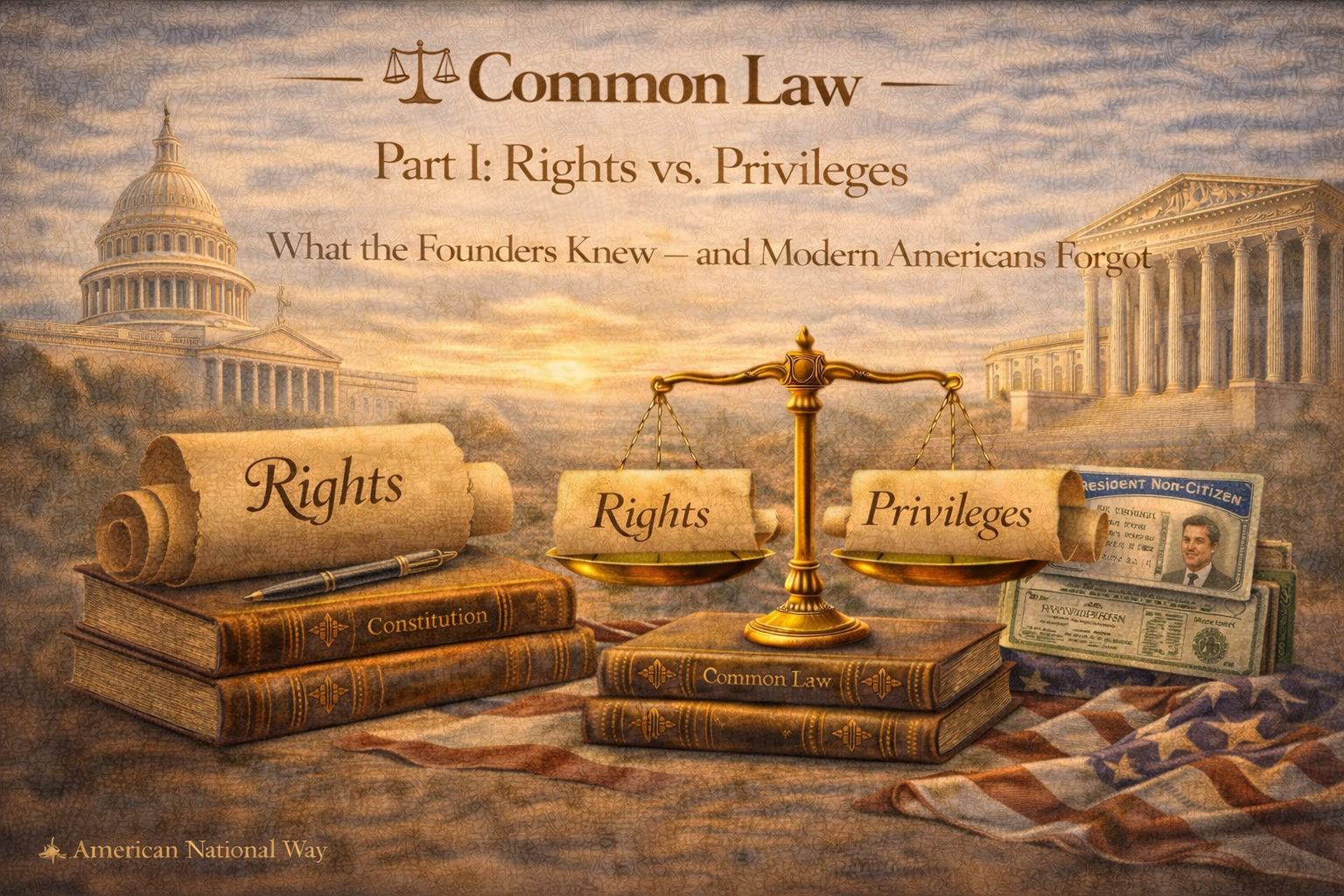
John Quade begins his argument where nearly all modern confusion begins: the failure to distinguish between a right and a privilege.
This is not a semantic issue. It is not philosophical hair‑splitting. In law, this distinction determines what can be taxed, regulated, revoked, or conditioned—and what cannot.
Quade’s position is blunt:
Rights come from God. Privileges come from men.
Everything that follows in this series depends on whether that distinction is true—and whether it still matters.
📜 What Is a Right?
In the classical understanding shared by the Founders, a right has three defining characteristics:
- It exists prior to government
- It does not require permission
- It cannot be lawfully revoked by human authority
Rights were understood as endowments, not grants.
This is why the Declaration of Independence does not say rights are given by government, but that they are endowed by the Creator. Government, in this framework, exists only to recognize and protect what already exists.
A right, therefore, cannot be licensed.
It cannot be taxed.
It cannot be conditioned on compliance.
🎟️ What Is a Privilege?
A privilege, by contrast, is something that:
- Is granted by an authority
- Exists only by permission
- Can be altered, suspended, or revoked
In legal terms, a privilege is always conditional.
Quade summarizes it this way:
A privilege is something that can be granted—and taken away—at the whim of the grantor.
Privileges are useful. They are not inherently evil. But they come with a cost that is rarely disclosed upfront: jurisdiction.
⚠️ Why This Difference Changes Everything
Under American law, a crucial rule applies:
Only privileges can be taxed. Rights cannot.
This is why income, activities, and property tied to licenses, registrations, and benefits are taxable—while rights, in principle, are not.
The mechanism is simple:
- Accept a privilege
- Agree to conditions
- Enter jurisdiction
- Become subject to regulation and penalty
This process does not require force.
It requires consent.
🧠 The Psychological Trap of “Rights Talk”
Quade points out a modern irony: people talk constantly about their rights, while almost never exercising any.
Much of what is called a “right” today is actually a regulated privilege:
- Licensed activities
- Permitted use of property
- Conditional benefits
- Contract‑based protections
When disputes arise, individuals are encouraged to sue—entering deeper into contractual systems that further remove them from natural rights and place them under administrative control.
“You sue, the attorney gets it all, and then you wonder why your rights are gone.” — John Quade
🧭 Choose This Day
Quade frames the issue not as political, but moral:
Choose this day whom you will serve.
To live under rights is to accept responsibility, self‑governance, and moral restraint.
To live under privileges is to accept supervision, permission, and dependency.
One offers freedom with accountability.
The other offers comfort with control.
🩸 Why the Founders Thought This Was Worth Dying For
The men who framed the American system believed that surrendering rights—even voluntarily—was a form of quiet enslavement.
They understood that once rights are exchanged for benefits, they are nearly impossible to recover without sacrifice.
This is why Quade insists the question is not merely legal, but existential:
Are rights worth dying for—or have we already traded them away for privileges we refuse to question?
🧱 What Comes Next
If rights and privileges are different in kind—and if privileges operate by consent—then the next question becomes unavoidable:
How is consent actually given in modern society?
That question leads directly to contracts, benefits, licenses, and jurisdiction.